When Government Gets Diaspora Engagement Right: What SLDIC London Showed

When it comes to diaspora engagement, Sierra Leone is taking a turn. Government is moving past speeches and goodwill to institutions, policy and real investment support for Sierra Leoneans abroad who want to build at home. If you want to know where that turn began, look to London.
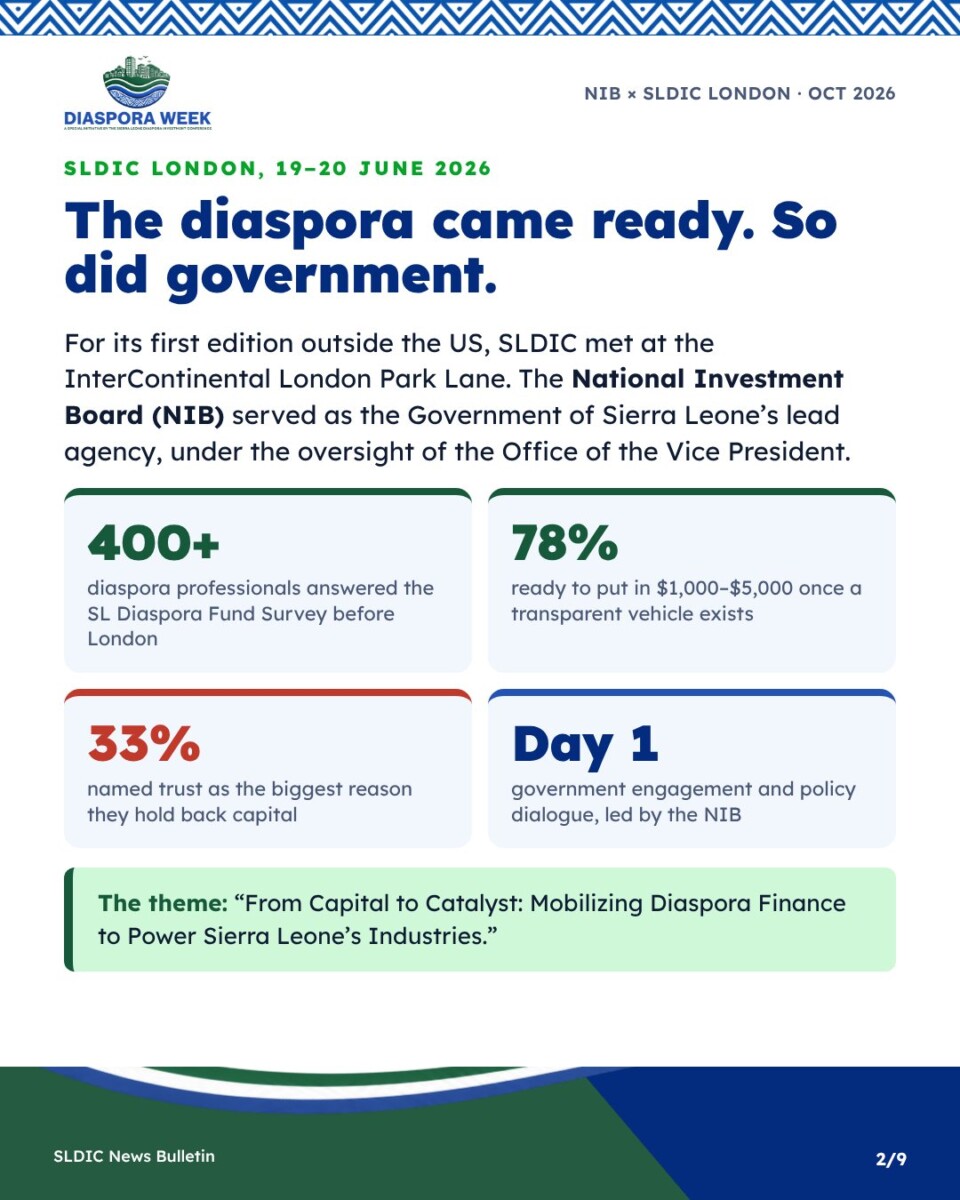
Not one, not two, but seven members of cabinet and the Governor of the Central Bank attended the Sierra Leone Diaspora Investment Conference (SLDIC) in London this June. It was the largest gathering of government leaders to engage the diaspora on putting their talent and capital to work for Sierra Leone. Leading the way was the National Investment Board (NIB).
Day 1 of the conference was government day. We put the country’s investment leadership in one room with diaspora professionals, business owners and first-time investors, and asked them to answer the hard questions directly. The diaspora came ready. Our pre-conference survey of more than 400 people found that 78% were ready to invest between $1,000 and $5,000, but only 33% said they trusted the systems back home. That gap between willingness and trust is exactly what these engagements are meant to close. Government is not pretending the shortcomings aren’t there. In his Day 2 keynote, the Vice President said it plainly: “We know that some of you have tried to invest and walked away frustrated.” Trust, he said, has to be earned, not announced. His answer was partnership: “The government does not pretend to have all the answers,” which is why it wants to build investment pathways with the diaspora, not just present them. The NIB came to London to start that work.
A partnership built months before London
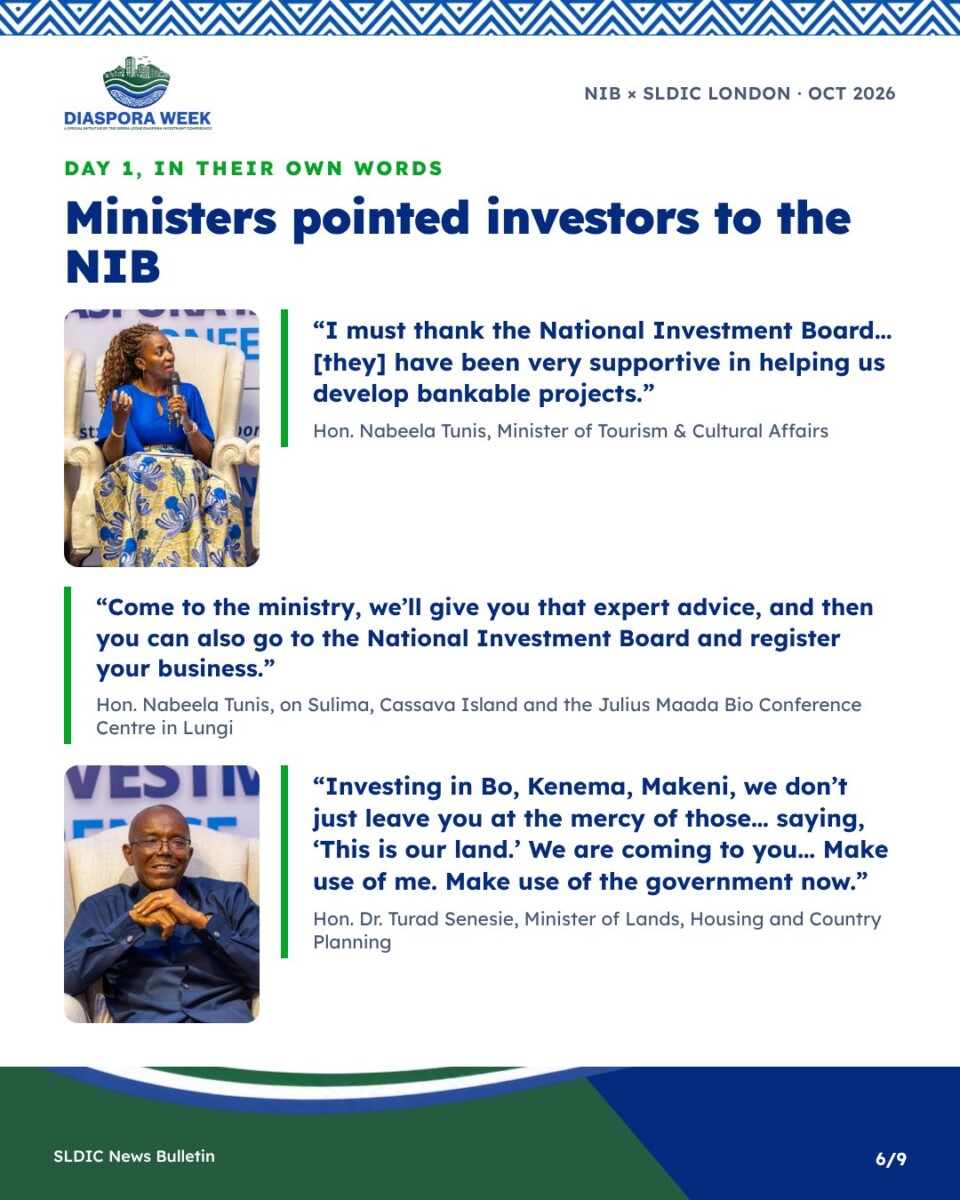
The NIB did not just turn up on the day. The partnership was built step by step:
- 18 March 2026: the NIB signs on as a partner of Sierra Leone Diaspora Week.
- 21 April 2026: the partnership is announced publicly.
- 19 June 2026: the NIB leads the Day 1 policy panel alongside the Ministry of Finance and the Ministry of Trade, moderated by Millicent Lewis-Ojumu.
- 20 June 2026: the Vice President delivers the Day 2 keynote, setting out government’s diaspora finance agenda.
- 30 September 2026: the NIB accepts our invitation to Freetown in December.
In its own words, the NIB sees the diaspora “not merely as remittance contributors, but as strategic investors and partners.” London was where that statement was put to the test in front of the people it is about.
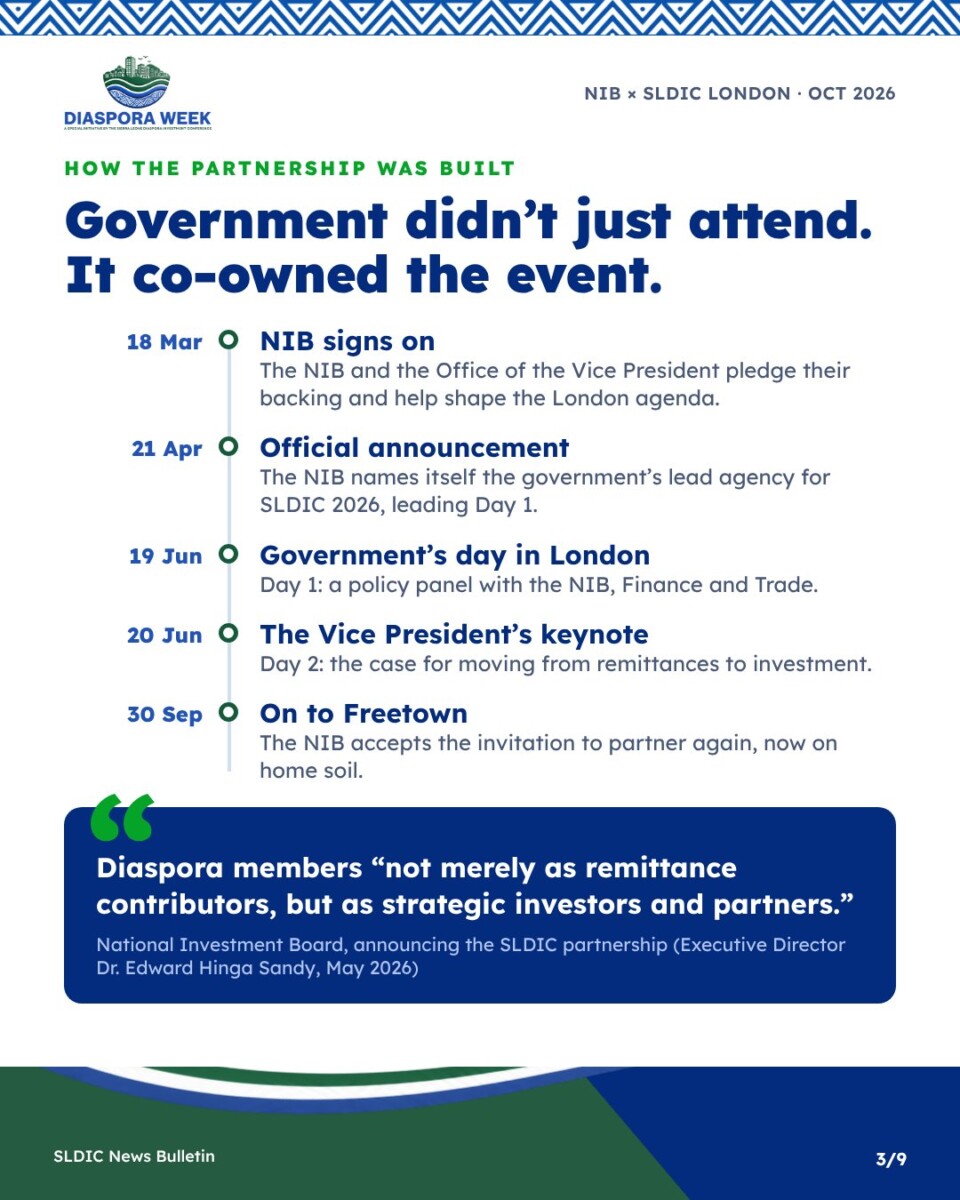
“What happens when there’s a problem on the ground?”
The sharpest question of the day came from the moderator, Millicent Lewis-Ojumu, a Solicitor of the High Court of England and Wales, and it was the one many people in the room were thinking. It is fine to talk about big PPP contracts and deals that go to parliament, she said, but what happens when an ordinary Sierra Leonean from the diaspora comes home to invest, maybe a little rusty in their Krio, and runs into a conflict at community level? Who protects them?
Dr. Edward Hinga Sandy, Executive Director of the NIB, answered with a concrete example rather than a promise. He explained that the NIB is rolling out an aftercare framework that “makes sure we are visiting investments, looking at the challenges, and actually trying to deal with those challenges.”
The NIB pointed to a major investment in pineapple cultivation in Pujehun District, where it had recently visited. “They had challenges with the community, and we were able to deal with that.”
That is the message diaspora investors need to hear: registering a business is only the start, and there is now an agency whose job is to stay with you after you invest.
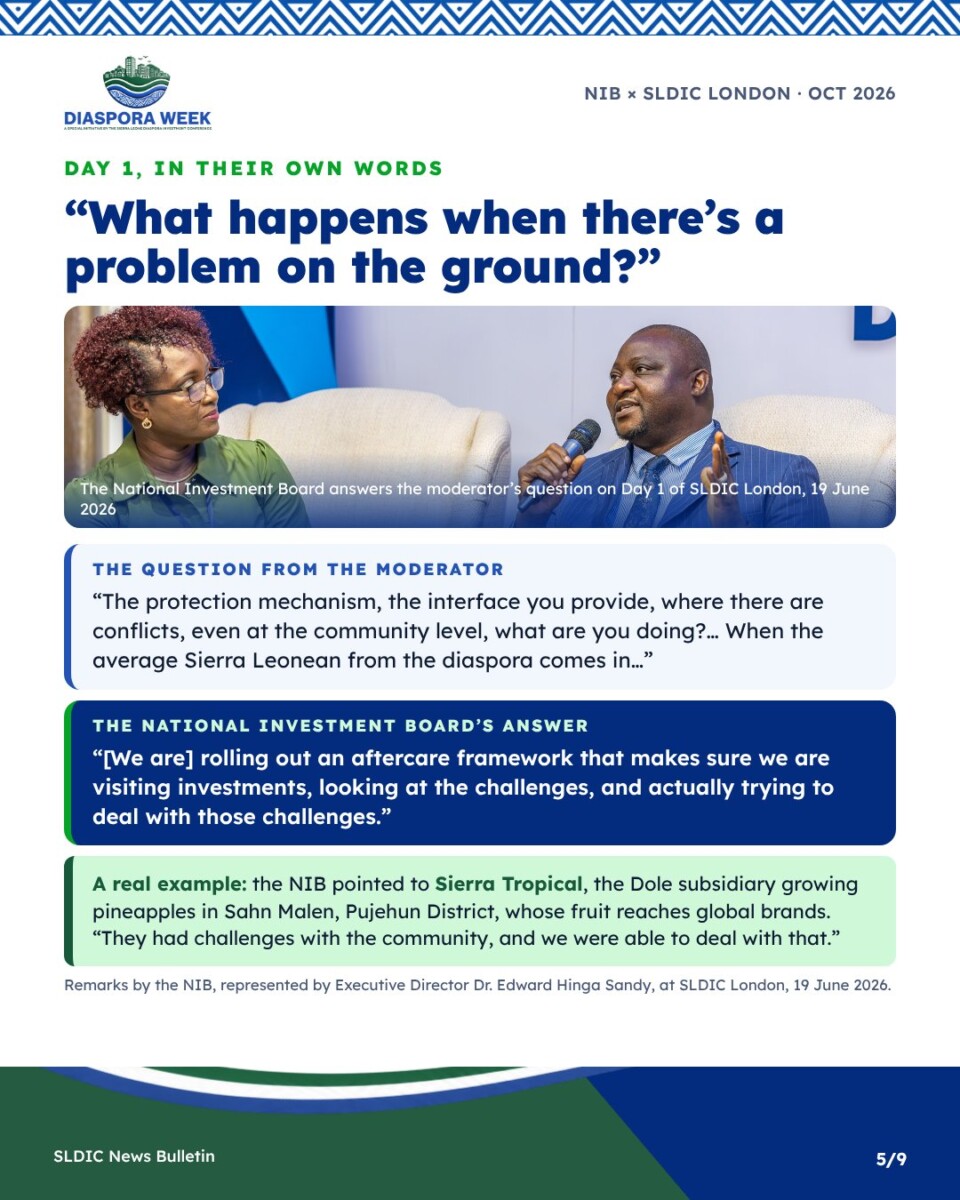
Ministers pointed investors to the NIB
One of the clearest signs of the NIB’s role came from the other government speakers. Ministers backed that up.
- Hon. Nabeela Tunis, Minister of Tourism & Cultural Affairs, credited the NIB directly: “I must thank the National Investment Board,” she said, adding that its team had been very supportive in helping her ministry develop bankable projects. She highlighted opportunities from the 40 kilometres of beaches at Sulima and Cassava Island to the Julius Maada Bio Conference Centre in Lungi, and closed with practical advice: come to the ministry for expert guidance, “and then you can also go to the National Investment Board and register your business.”
- Hon. Dr. Turad Senesie, Minister of Lands, Housing and Country Planning, spoke to land, one of the first questions any investor asks. For investors looking at Bo, Kenema, Makeni and beyond, government now takes the lead: “We make sure that we acquire the land, we secure it, and then it is allocated to you.” He described the ministry as guiding the process and supporting other agencies, from Tourism to Trade and Health. His message to the room was simple: “Make use of the government now.”
The Vice President pointed back to the NIB too. In his Day 2 keynote, he explained how government has opened up direct dialogue with businesses, big and small, so they can raise obstacles with the President, the Vice President and ministers. He credited the point to what the NIB’s Executive Director had told the conference the day before.
Together, it showed ministries and the NIB working side by side: the ministries opening up land, projects and sector expertise, and the NIB as the front door where diaspora investors register and get support.
What the NIB is fixing at home
What the NIB said in London lines up with what it has been building in Sierra Leone this year:
- A One Stop Shop for investors. It opened on 30 March 2026, bringing the agencies an investor needs under one roof.
- Faster business registration. The NIB is working toward a 24-hour registration target.
- Registration linked to the National ID. Since April 2026, business registration is linked to the NIN through the NCRA, making it easier to verify who you are dealing with.
- A plan with aftercare built in. The National Investment Strategy 2025–2030 includes the aftercare work the NIB described in London, so support continues after an investment is made.
For a diaspora investor, these are the practical things that turn “I want to invest at home” into a registered, protected business.
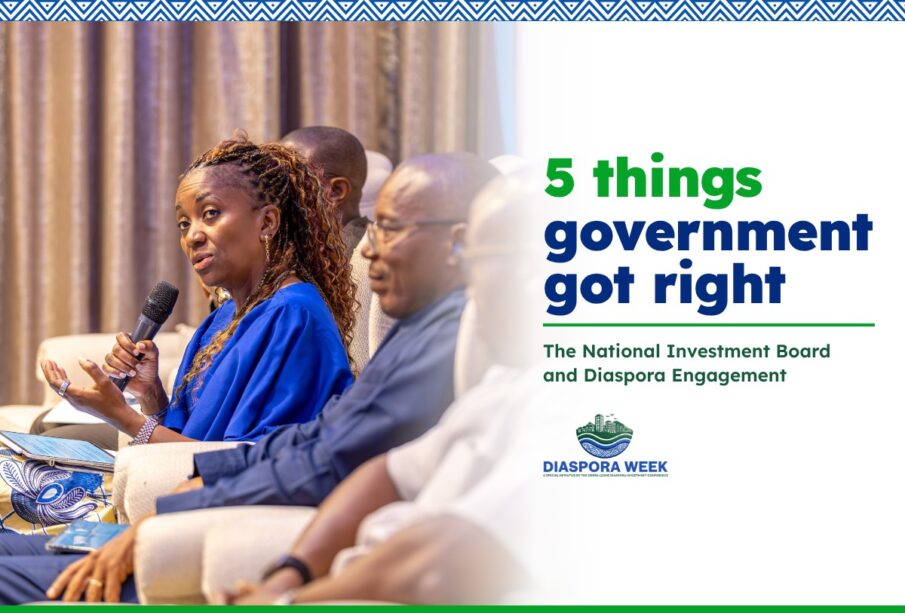
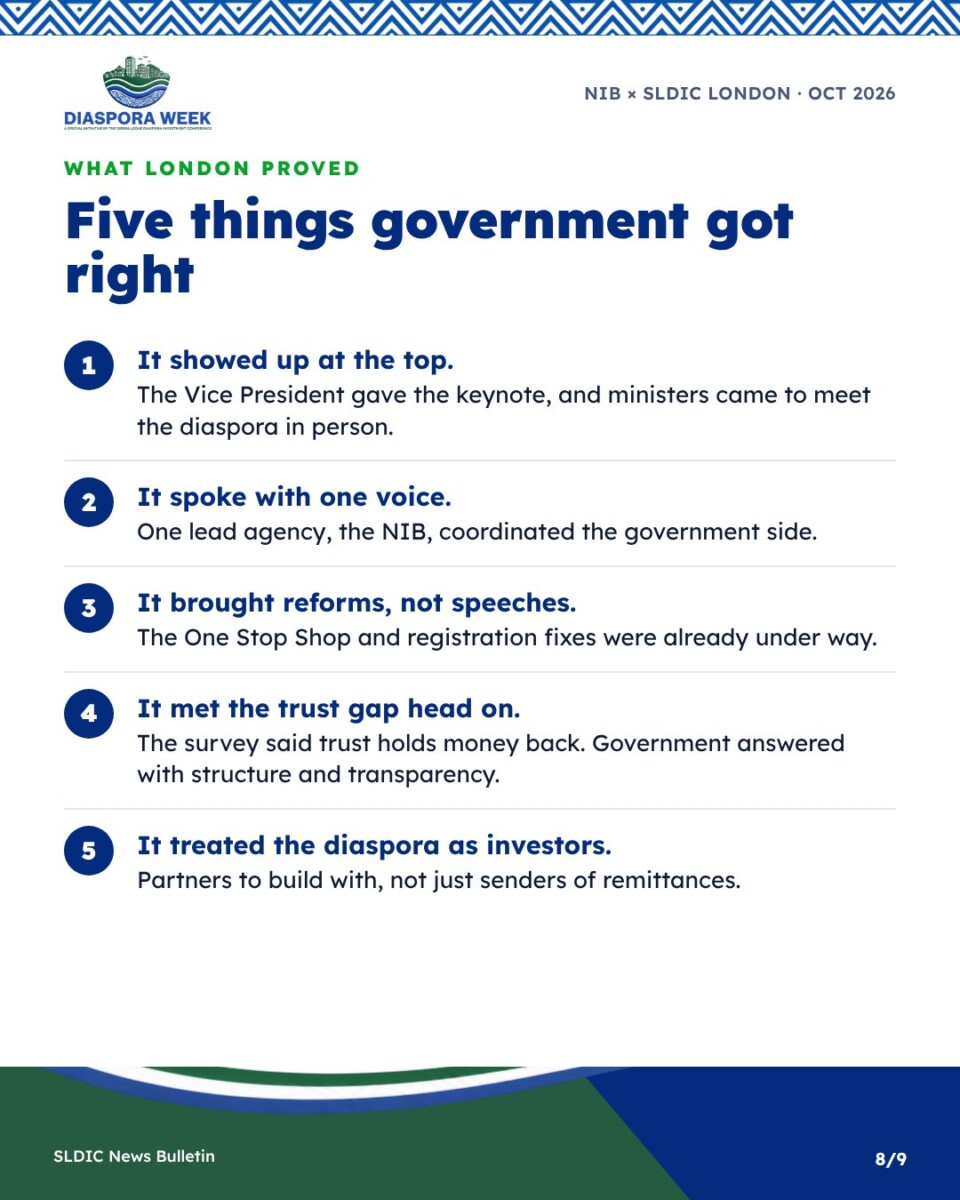
Five things government got right in London
- It showed up together. The NIB, Finance, Trade, Tourism and Lands were on the same stage on the same day, so the diaspora heard one government, not scattered agencies.
- It answered hard questions in public. Community conflict, land disputes and trust were asked about openly and answered directly.
- It gave real examples. A pineapple plantation in Pujehun and land allocated for Tacugama Sanctuary are proof, not slogans.
- It named a front door. Ministers consistently sent investors to the NIB to register and get support.
- It followed up. The partnership did not end in London. The NIB has accepted the invitation to continue the conversation in Freetown.
Download the full bulletin
Everything in this post, plus the full timeline and what the NIB is building at home, is in our free nine-page bulletin, When Government Gets Diaspora Engagement Right.
Join the conversation in Freetown
London showed what is possible when government and the diaspora sit at the same table. In December, we bring that conversation home, with the National Investment Board back in the room.
- When: Monday 28 – Tuesday 29 December 2026
- Where: Radisson Blu Mammy Yoko Hotel, Freetown
- Pass: $125 Conference Pass, covering both days with breakfast and lunch
Programme and session times are subject to change.




-
When Government Gets Diaspora Engagement Right: What SLDIC London Showed
At SLDIC London, government showed up ready, and the National Investment Board ... -
-
-