Sierra Leoneans Eating Local Rice Up to 73%: Agric Ministry Feed Salone at Three

Three years into Feed Salone, Sierra Leone is growing more of its own rice, importing far fewer eggs and onions, and cutting the share of families going hungry. But big projects are running behind, and most of the money pledged has yet to reach the field.
Those are the headlines from the Feed Salone Year Three Report, published by the Ministry of Agriculture and Food Security under Minister Dr Henry Musa Kpaka. It covers October 2025 to September 2026, a year when the Middle East conflict pushed up the price of fuel and fertiliser.
Year three in numbers
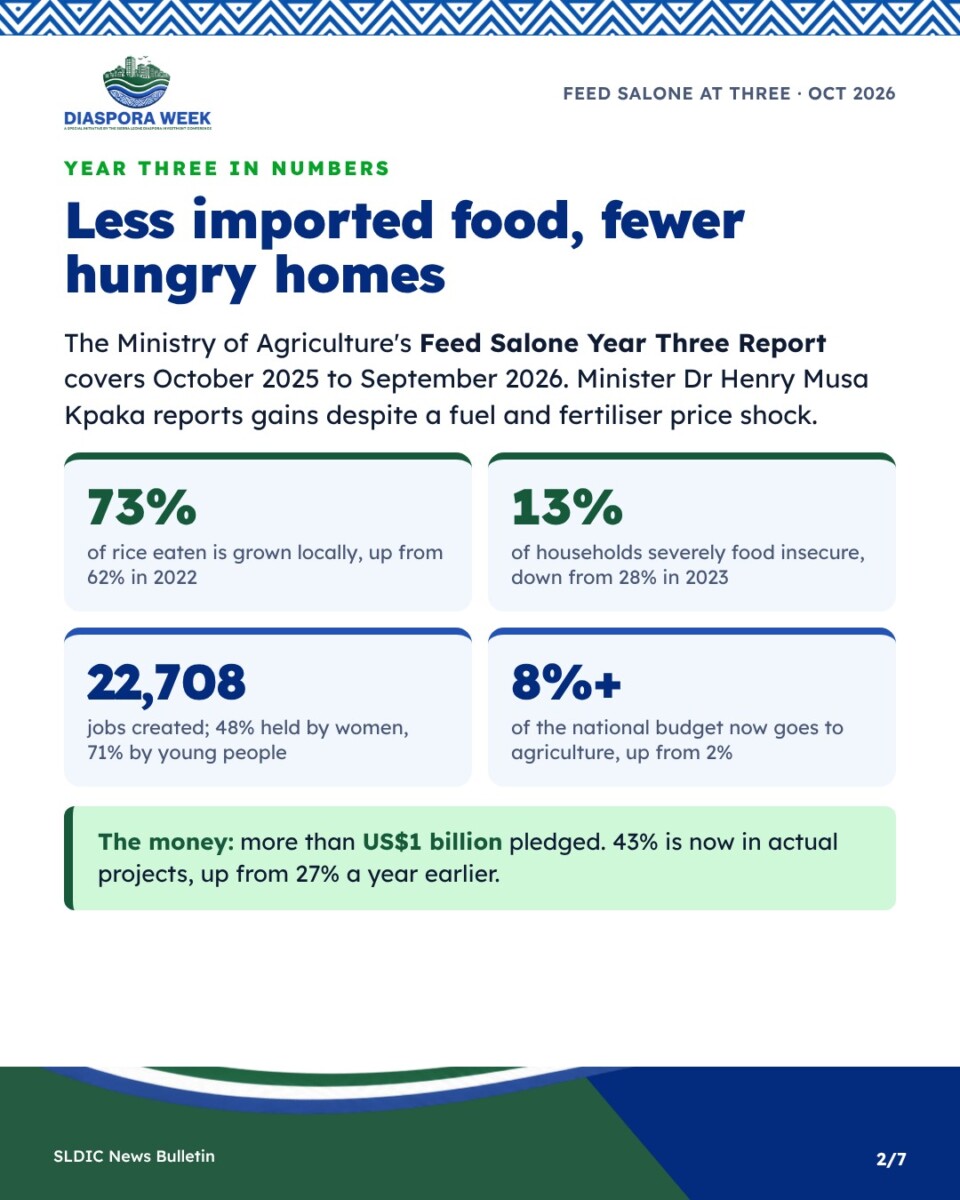
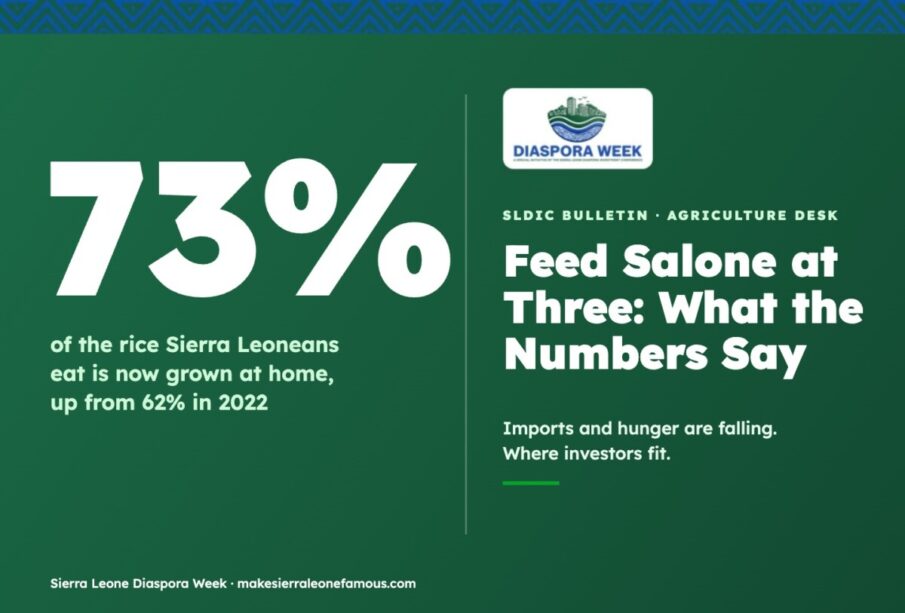
- 73% of the rice Sierra Leoneans eat is now grown at home, up from 62% in 2022.
- 13% of households are severely food insecure, down from 28% in September 2023. The target is 10%.
- 22,708 jobs created, 48% held by women and 71% by young people.
- More than 8% of the national budget now goes to agriculture, up from 2% before Feed Salone.
- More than US$1 billion pledged. 43% is now in actual projects, up from 27% a year earlier.
Rice: more home-grown, smaller import bill
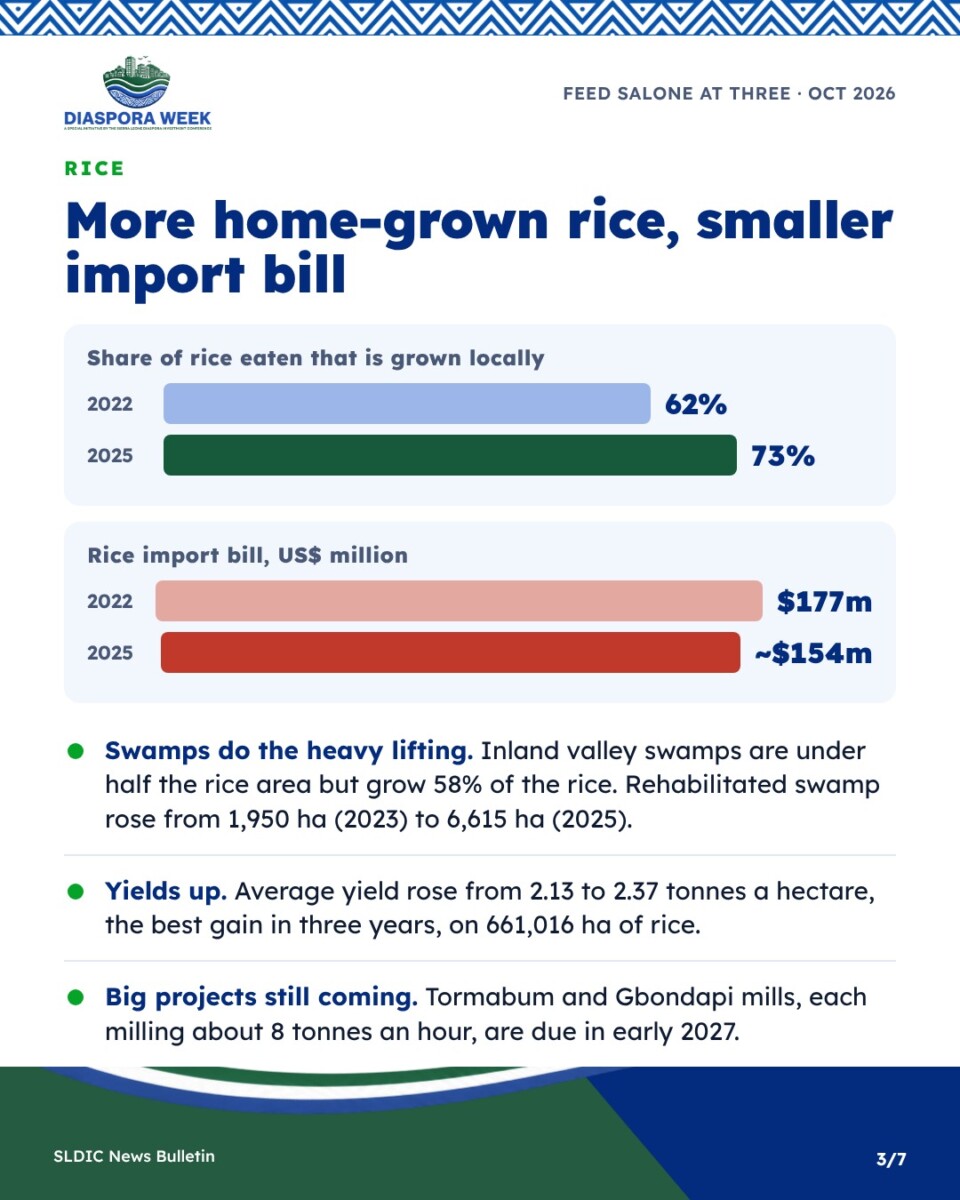
The rice import bill has fallen from about US$177 million to about US$154 million. Rice now covers 661,016 hectares, and average yields rose from 2.13 to 2.37 tonnes a hectare, the best gain in three years.
Inland valley swamps are doing the heavy lifting. They make up under half the rice area but grow 58% of the rice, at almost twice the yield of upland farms. Rehabilitated swamp land grew from 1,950 hectares in 2023 to 6,615 hectares in 2025.
The biggest pieces are still to come. New mills at Tormabum and Gbondapi, each able to mill about 8 tonnes of rice an hour, are due in early 2027.
Eggs and onions: the fastest wins
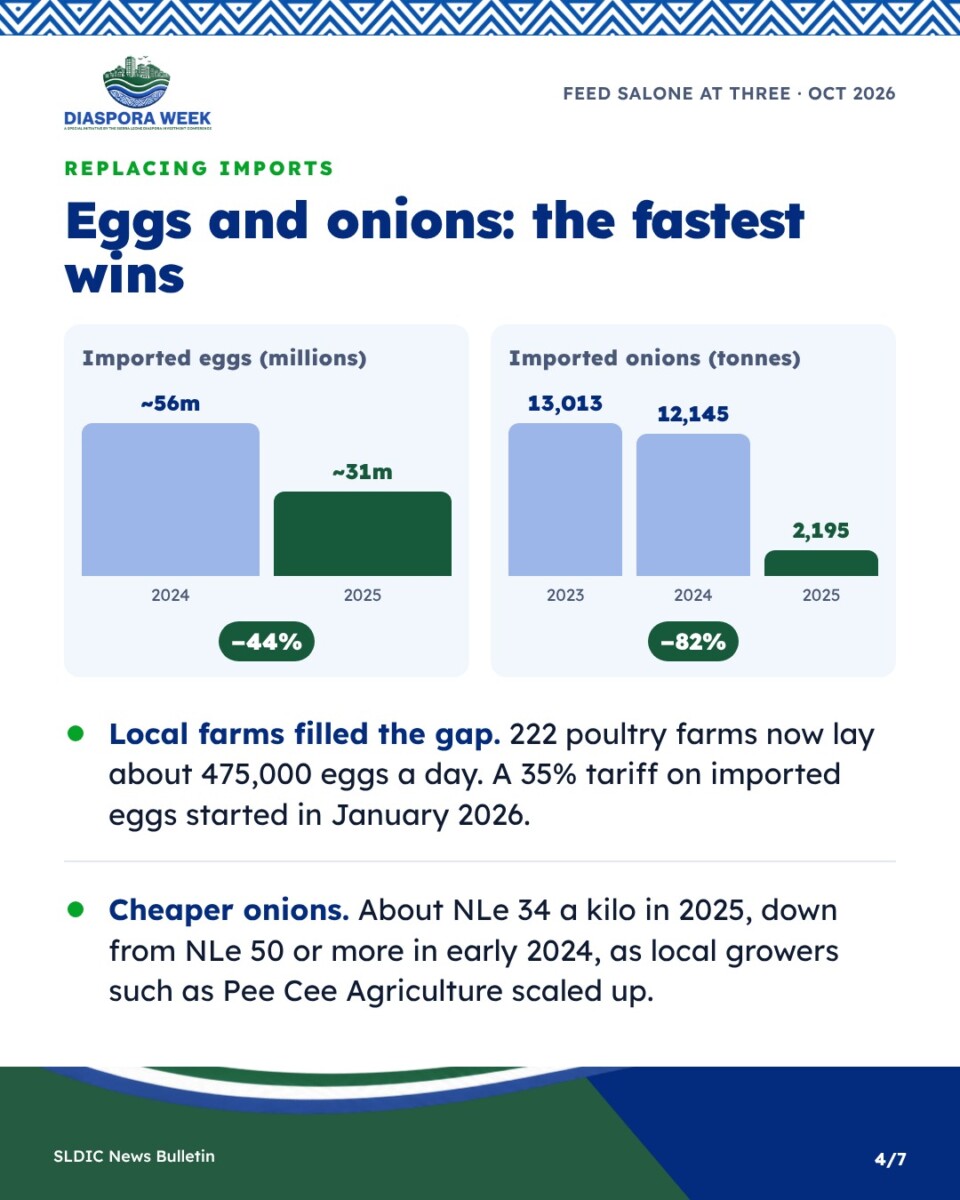
Import substitution has moved fastest in poultry and onions:
- Eggs. Imports fell from about 56 million eggs in 2024 to about 31 million in 2025, a drop of more than 40%. A survey of 222 local poultry farms found about 475,000 eggs laid a day. A 35% tariff on imported eggs took effect in January 2026.
- Onions. Imports fell 82%, from 12,145 tonnes in 2024 to 2,195 tonnes in 2025. Onion prices dropped to about NLe 34 a kilo, from NLe 50 or more in early 2024, as local growers such as Pee Cee Agriculture scaled up.
Cash crops: growth, with big swings
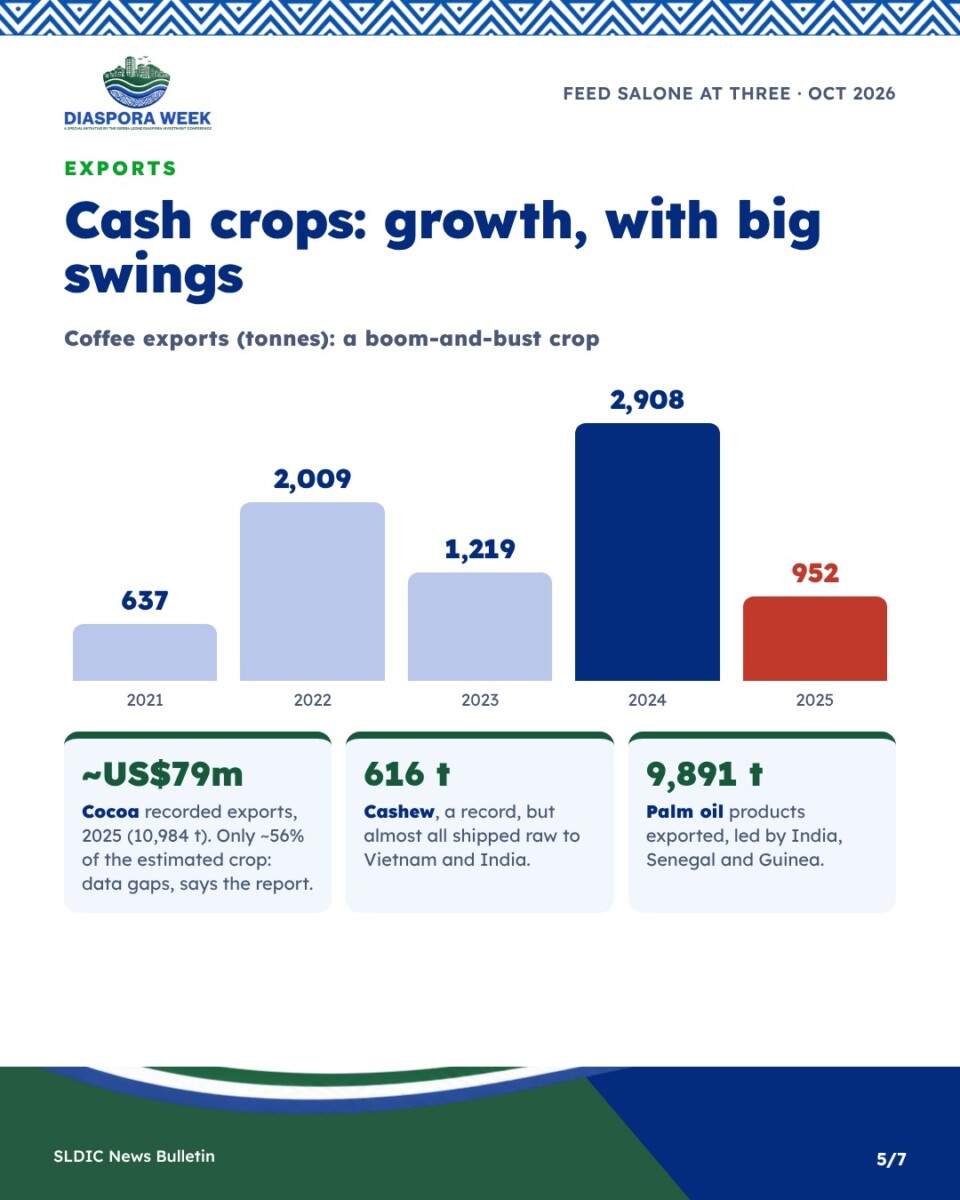
- Coffee exports swing wildly: 2,908 tonnes in 2024, then 952 tonnes in 2025, worth about US$4.8 million. The report warns this makes smallholder income unpredictable.
- Cocoa exports recorded in 2025 were 10,984 tonnes, worth about US$79 million, mostly to the Netherlands. That is only about 56% of the estimated crop, which the report puts down to data gaps.
- Cashew exports hit a record 616 tonnes in 2025, but almost all of it was shipped raw to Vietnam and India. Only about 100 tonnes were processed at home.
- Palm oil products exported reached 9,891 tonnes, led by India, Senegal and Guinea.
What still lags
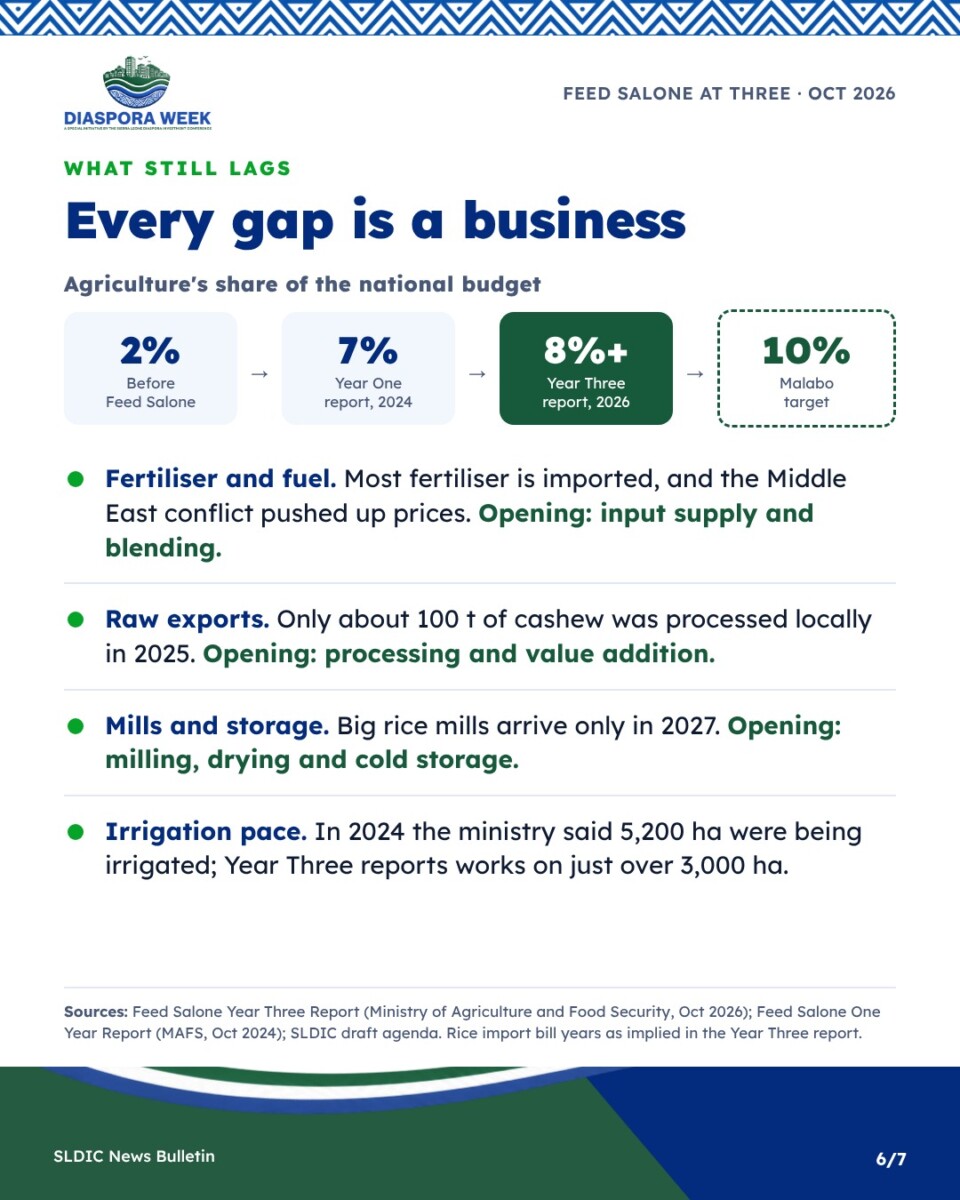
The Year One report in 2024 said agriculture’s share of the budget had risen from 2% to 7%, with a target of 10%. Two years later, it stands at just over 8%.
- Fertiliser and fuel. Most fertiliser is imported, leaving farmers exposed to price shocks.
- Raw exports. Cashew and cocoa still leave the country with little value added.
- Mills and storage. The big rice mills will not be ready until 2027.
- Irrigation. In 2024 the ministry said 5,200 hectares at Tormabum and Gbondapi were being irrigated. The Year Three report describes works covering just over 3,000 hectares.
For investors, each of these gaps is an opening: input supply, processing, milling, drying and cold storage.
Join the conversation: Feed Salone in Action
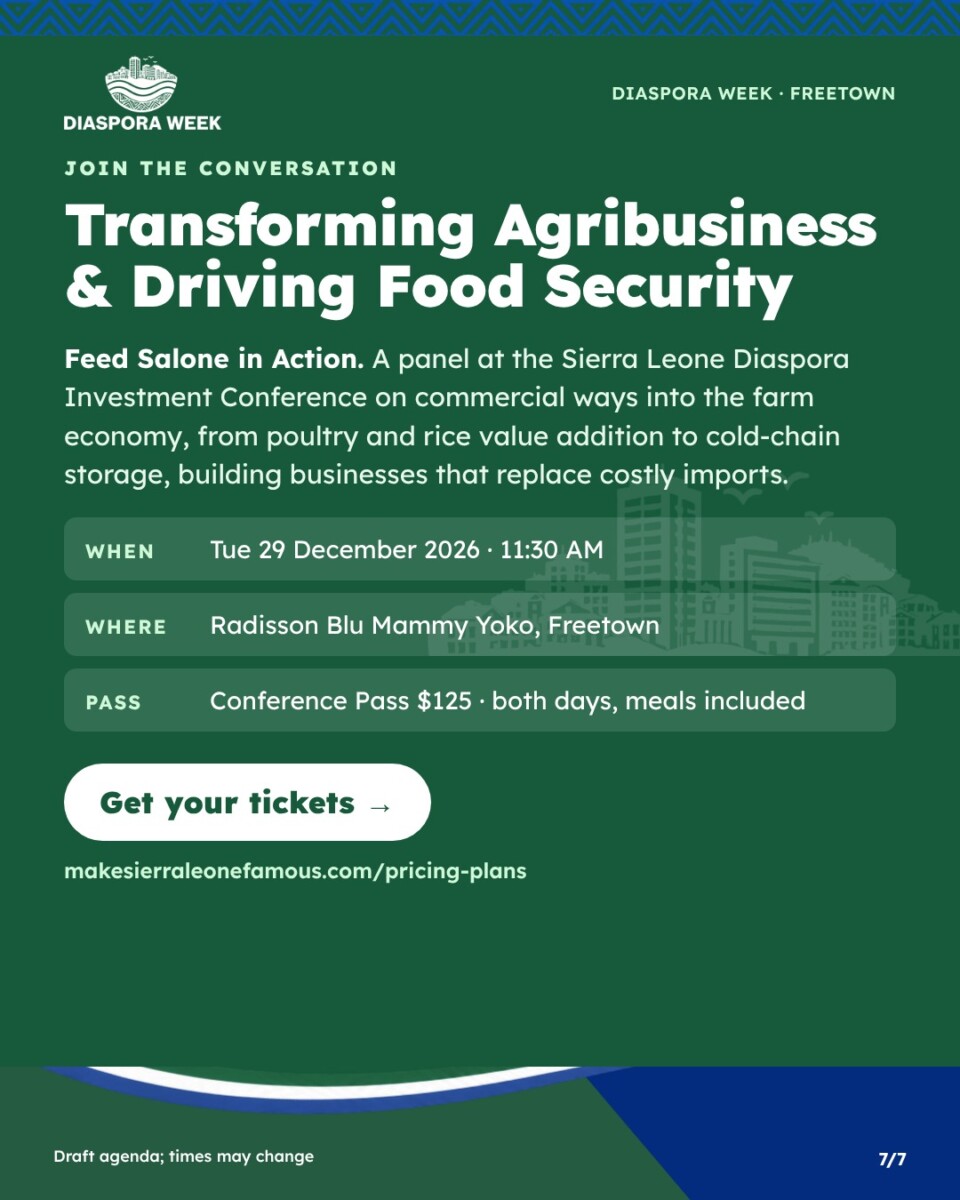
These openings are the focus of “Transforming Agribusiness & Driving Food Security (Feed Salone in Action)”, a panel at the Sierra Leone Diaspora Investment Conference in Freetown. It explores commercial ways into the farm economy, from poultry production and rice value addition to cold-chain storage, and how to build businesses that replace costly imports.
- When: Tuesday, 29 December 2026, 11:30 AM
- Where: Radisson Blu Mammy Yoko Hotel, Freetown
- Pass: Conference Pass, $125, covers both days with breakfast and lunch
Sources: Feed Salone Year Three Report (Ministry of Agriculture and Food Security, October 2026); Feed Salone One Year Report (October 2024). Programme and session times are subject to change.






-
Sierra Leoneans Eating Local Rice Up to 73%: Agric Ministry Feed Salone at Three
Three years in, Feed Salone has cut rice, egg and onion imports ... -
-
-