

Freetown City Council Installs First Air Quality Monitors to Track City Pollution

The Freetown City Council (FCC) has on the 15th of May 2026 begun the installation of 12 air quality monitoring stations across the capital, marking a major step toward protecting public health. FCC Officials were at the Sierra Leone Broadcasting Cooperation (SLBC) compound in New England earlier today to set up the very first device in this citywide network.
For too long, air pollution in Freetown has been an “invisible” threat that only became clear when residents suffered from asthma or other breathing issues.
This initiative is closing a long-standing data gap in the city.
Mayor Yvonne Aki-Sawyerr, who was at the SLBC compound this morning, emphasized that this data is the key to a healthier city. “These monitors will reveal exactly what’s in the air we breathe and when exposure to pollution spikes,” she said.
This allows authorities to identify the most dangerous times for environmental health which were previously impossible to track.
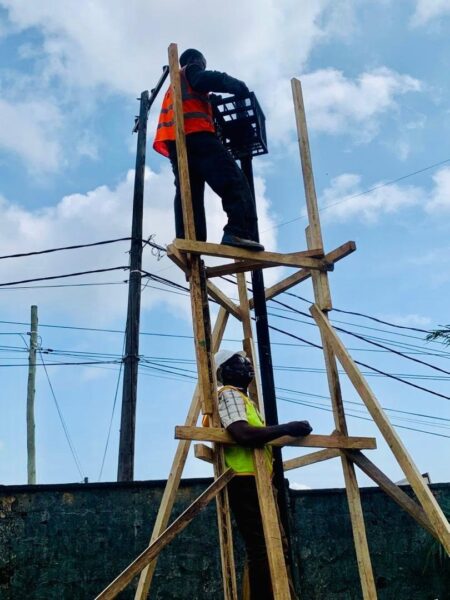
The first of 12 air quality monitors being installed at SLBC
Identifying the Causes of Smog in Freetown
Recent environmental data, including the Freetown Heat Action Plan, shows that air pollution in the capital is rising. Research highlights that waste management is the biggest problem, causing about 42% of the city’s emissions due to the open burning of rubbish.
Transportation is another major factor, contributing 28% of the city’s pollution. Studies at busy areas like Kissy Road and Wilkinson Road have found high levels of pollutants caused by traffic jams and poorly maintained engines. Additionally, the city’s heavy use of diesel generators continues to push more harmful smoke into the atmosphere.
To clean up the air, the Mayor called for immediate action from residents and other government agencies, she urged Freetonians to stop burning rubbish and instead use FCC-approved waste collectors.
The Sierra Leone Road Safety Authority (SLRSA) were also encouraged to strictly enforce roadworthiness to reduce harmful smoke from cars and “poda-podas.”
Mayor Aki-Sawyerr also called upon The Electricity Distribution and Supply Authority (EDSA) to stabilize the power supply to help reduce the city’s dependence on smoky diesel generators
Building a Resilient City

The FCC technical team coordinating the first air monitor installation
The rollout was witnessed this morning by officials including FCC Climate Change Officer Yatta Kallon, a member of the MDU Climate Change team Miracle Saccoh , and representatives from the Murialdo Technical Institute.
“This project is about making the invisible risks visible,” said Esther Yatta Kallon, the FCC Climate Change Officer. “By gathering this data, we can finally see the pollution hotspots in our city and develop real solutions to protect our communities.”
This move toward using hard evidence is a hopeful sign for a city where smoke and dust are part of daily life. As the Mayor noted, “Good air quality is essential for good health.”
WRITTEN BY DAVIDNETTE VANDY







-
Freetown City Council Installs First Air Quality Monitors to Track City Pollution
The Freetown City Council (FCC) has on the 15th of May 2026 ... -
-
-