
Diaspora Bonds Explained: How other African Countries Are Turning Their Diaspora Into Investors


From Sending Money To Investing Money
Every December, thousands of Sierra Leoneans land at Lungi with bags full of gifts and pockets full of cash for family.
In 2025, Sierra Leoneans abroad send over $322 million home as remittances back home. Most of it is spent on family support, food, and rent.
What if a part of it was invested? What if you could lend $1000 to Sierra Leone for five years, get 7%- 9% interest back every year, and that money builds a solar farm in Bo or houses in Freetown? That is a Diaspora Bond. And 2026 is the year Africa is going all-in on it.
What Is A Diaspora Bond?
At its core, a bond is a debt instrument. Governments often need capital to fund long-term development projects, such as energy infrastructure and housing. However, tax revenues may not cover these costs upfront. So it borrows.
A bond is how that borrowing is formalised. An investor lends the government a fixed amount, for a defined period, typically five to ten years. In return, the government commits to pay.
Unlike donation or remittance, a bond is a contractual obligation. It has a yield, a maturity date, and a legal framework. It is investment, not charity.
A diaspora bond takes this conventional financial instrument and repositions the investor base. Instead of borrowing from the International Monetary Fund(IMF), World Bank or bilateral lenders with policy conditions and geopolitical scrutiny, the government issues that same bond to its own citizens abroad, denominated in dollars, pounds or euros and distributed through regulated banks in London or New York.
For the state, it mobilises hard currency from a loyal base, diversifies its debt, and replaces dependency with self-financing.
For the diaspora, it converts consumption-driven remittances into productive capital. Instead of a 3% to 4% return from a UK or US savings account, you earn 7% to 9%, while financing a tangible asset that outlasts a one-week remittance, with your capital returned at the end.
How Other African Countries Have Used Them
In 2011, Kenya issued a 12 year infrastructure bond with a diaspora window. It offered a 12% return and achieved a 70% subscription rate,one of the strongest performances on the continent at the time. But there was a glitch , it limited the participation to Kenyan citizens only and set high minimums, so second-generation Kenyans were locked out.
In 2026, Kenya is targeting $500 million in diaspora bonds, with World Bank’s Multilateral Investment Guarantee Agency(MIGA) helping to structure it to manage political risk.
Ghana tried in 2017 with the Golden Jubilee Savings Bond at 15% interest. It raised only 40% of its target, with diaspora contributing just 6%. The reason was clear. It excluded dual nationals, second-generation migrants and non-citizen affiliates. In April 2026, Bank of Ghana Governor, Johnson Pandit Asiama, launched Remit2Invest at a Washington roundtable. Ghana’s remittances hit nearly $7.8 billion in 2025 and now outpace foreign direct investment. The new plan includes diaspora bonds and foreign -currency products so Ghanaians abroad can invest without cedi risk.
This year, Burkina Faso announced its Patriotic Bond in early March 2026. It opened on May 6 and closed on June 6 with 151.5 billion CFA francs raised, beating its 125 billion target.

What This Means For Sierra Leone
While Kenya, Ghana and Burkina Faso have already tested the model, Sierra Leone is now designing its own.
That shift was made official at the Sierra Leone Diaspora Investment Conference(SLDIC) London 2026, which convened over 400 delegates including senior government officials and diaspora investors.
According to the 2026 Sierra Leone Diaspora Investment Conference report, the conversation has moved from family support to structured national investment.
Opening the conference, founder of SLDIC, Vickie Remoe, presented findings from the Sierra Leone Diaspora Fund Survey 2026. As detailed in the report:
“Results revealed that 58% of respondents view social impact as their primary motivation for sending funds home. However, 33% identified a lack of trust and 24% cited limited transparency as primary barriers to investing.”
That trust gap is exactly what a diaspora bond is meant to solve.
In his keynote speech, Vice President, H.E Dr. Mohamed Juldeh Jalloh confirmed the government’s direction.
“A national diaspora finance framework is currently under development and prioritized within the government’s integrated National Finance Framework,” he confirmed.
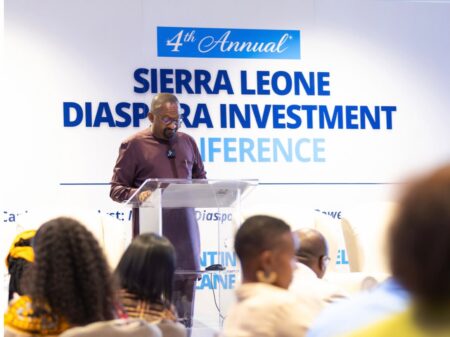
The Vice President, His Excellency Dr. Mohamed Juldeh Jalloh speaking at SLDIC 2026 in London
For Sierra Leone, where official World Bank data shows personal remittances were about $321 million in 2024, channeling even a fraction of that into regulated bonds for energy, health or agriculture would mean jobs, tax revenue and infrastructure, not just consumption.
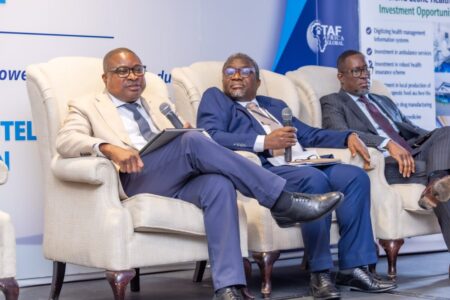
Dr. Ibrahim Stevens, Governor of the Bank of Sierra Leone (left), Idrissa Kanu, Director of Revenue and Tax Policy, Ministry of Finance (middle); and Sebastian Ashong-Katai, Managing Director, Ecobank Sierra Leone (right) in a panel at the SLDIC 2026 London
How Will the Sierra Leonean Diaspora Build Their Bond? SLDIC 2026 Freetown will Discuss That
For the first time, the Sierra Leone Diaspora Investment Conference (SLDIC) will be coming to Freetown, Sierra Leone.
The SLDIC will take place on December 29–30, 2026, at Radisson Blu Mammy Yoko Hotel, featuring keynote speeches, policy panels, a vendor and SME showcase, a welcome cocktail, and the Diaspora Excellence Awards Gala.
The SLDIC forms part of Sierra Leone Diaspora Week, founded and curated by Vickie Remoe, the conference’s founder and chair.
The week is structured in three phases.
Structured in three phases, the week opens with the investment phase on December 28–29, 2026, highlighting the SLDIC event. The celebration phase runs from December 30, 2026, to January 2, 2027, featuring the Diaspora Sports Day and Beach Bonfire, culture days, and The Song of Njama theater performance. It concludes with the building phase from January 4–5, featuring an Investment Bootcamp and a Trade, Agribusiness, and Eco-Tourism Tour.
Discover the ticket options available for the upcoming conference and Sierra Leone Diaspora Week:
- Conference Delegate Pass ($125): Ideal for attending the conference only. Pass holders gain access to 2 keynote speeches, 8 panel discussions, and the SME showcase, as well as breakfast and lunch on both days at the Radisson Blu.
- Vendor Package ($500): Designed for small businesses looking to highlight their brands to over 1,000 diaspora investors across both days. Includes a directory profile, photo, guide listing, social media feature, plus lunch and refreshments for both days.
- All-Access Pass: Provides full access to all week activities, including premier conference seating with daily breakfast and lunch, VIP seating at the Diaspora Excellence Awards Gala, entrance to the Diaspora Wars and bonfire, and much more!
Ready to secure your spot? Head over to https://makesierraleonefamous.com/pricing-plans/ and grab your ticket today!






-
President Bio Commissions Sierra Leone Ocean Shipping Company
H.E President Julius Maada Bio on Monday, 19th October 2026, commissioned the ... -
-
-


