
Can I Play for Leone Stars? How Diaspora-Born Players Qualify
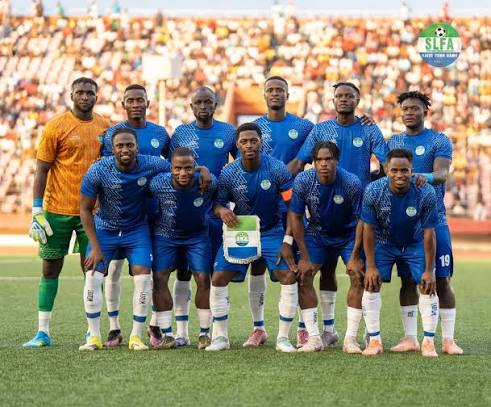

For a young footballer born and raised in England, the United States, Germany or another country, having Sierra Leonean parents or grandparents can create a pathway to representing Leone Stars. But ancestry alone does not guarantee eligibility.
FIFA’s rules require players to meet nationality and sporting eligibility conditions, particularly when they have already represented another country at international level. They also decide whether a player must obtain approval to change international allegiance. As Sierra Leone looks to strengthen its national team with talent from abroad, understanding these rules matters for players, families, agents and supporters.
The rules below are drawn from Articles 6 to 10 of FIFA’s Regulations Governing the Application of the Statutes (May 2024 edition). Readers should check the latest edition, as FIFA can amend the text.
Who qualifies to represent Leone Stars?
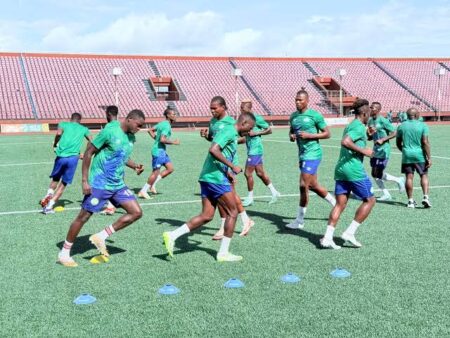
Leone Stars warming up before the match against Liberia
The starting point is nationality. Article 6(1) of the regulations makes a person eligible for a country’s representative teams if they hold a permanent nationality that does not depend on residence. Article 6(2) then separates holding a nationality from merely being eligible to obtain one. A player who could apply for a Sierra Leonean passport is not yet eligible; the nationality must actually be held.
For players who hold more than one nationality, Article 7(1) requires at least one further connection to the association concerned. The player must have been born on its territory, or have a biological parent or grandparent born there, or have lived there for at least five years.
This means a footballer born in London to Sierra Leonean parents may have a route to representing Leone Stars. However, the player’s citizenship status and international playing history must still be assessed individually.
A separate rule, Article 8, applies to players who acquire a new nationality, for example through naturalisation. In addition to the birth and family links above, residence can qualify a player: three years if they began living in the country before age 10, and five years if they arrived at 10 or older. A player relying on residence after arriving between 10 and 18 must also show the move was not made to play for the national team, and must apply to the Football Tribunal.
Does having a Sierra Leonean parent or grandparent guarantee eligibility?
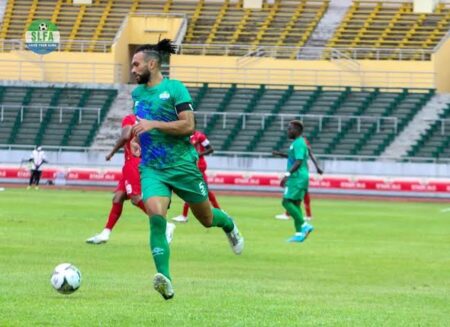
Former Leone Stars Captain Steven Caulker in action
No. Family heritage may supply the required connection, but the player must also establish the required nationality.
A Sierra Leonean surname, membership of the diaspora or a relative from the country is not enough. Relevant documents may include birth certificates, parents’ or grandparents’ birth records, passports and evidence of nationality. The Sierra Leone Football Association (SLFA) and FIFA must assess the evidence and decide whether the applicable requirements are met.
What if the player has represented another country?

Steven Caulker in England Jersey
This is where the process becomes more complicated.
The starting point is Article 6(3). A player who has appeared in an official competition, at any level, for one association generally cannot play for another, unless Article 10 allows it. Article 10(1) lets a player change association “only once”.
Representing England, the Netherlands, Germany or another country at youth level does not necessarily rule a player out. Article 10(2) sets out several routes depending on the player’s history:
- Youth or non-senior official matches only. If the player already held Sierra Leonean nationality when first fielded for the other country, a switch can be granted. If not, the player’s last official match for that country must have come before their 21st birthday, and they must meet the connection tests in Article 7 or 8.
- Senior (“A”) international appearances. The player must have held Sierra Leonean nationality at their first official match for the other country, and their last official match must have come before turning 21. They can have played no more than three senior matches, official or friendly, and at least three years must have passed since the last one. They must also never have played in a World Cup or continental championship final tournament.
The procedure matters too. The request must be submitted through the national association to FIFA’s Football Tribunal (Article 10(4)). While it is pending, the player cannot represent any national team (Article 10(7)). And a player cannot turn out for the new association in any competition in which they already played for the old one (Article 10(3)).
Players should not rely on assumptions or social media discussion to determine their status. A formal decision may be required before they can represent Leone Stars.
Lessons from players with Sierra Leonean roots
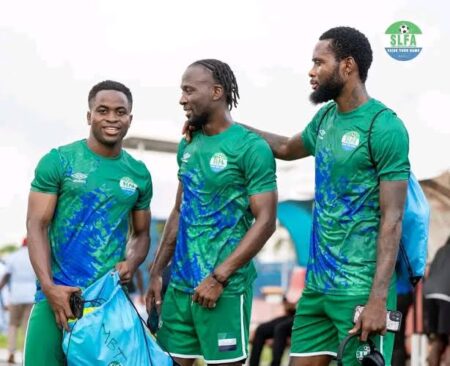
Leone Star players after the match against Egypt
Sierra Leone has previously benefited from players whose international careers involved other national associations.
Steven Caulker, the former England international defender, qualified to represent Sierra Leone through his paternal grandfather. In 2021, FIFA approved his change of association, allowing him to play for Leone Stars.
Issa Kallon, born in the Netherlands, also received FIFA approval to switch to Sierra Leone after representing the Netherlands at youth levels. His case showed that youth international appearances do not automatically close the door to another national team.
These examples show why the details of a player’s international history matter as much as their family background.
What about players who have represented England at senior level?
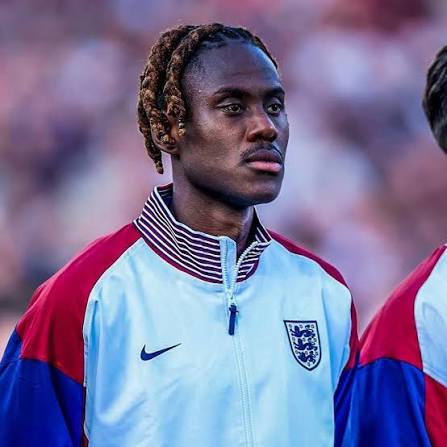
Trevor Chalobah in England Jersey
The case of Trevoh Chalobah shows why timing matters.
Born in Freetown, Chalobah represented England at youth level. In 2024, the SLFA confirmed it had contacted him about the possibility of representing Sierra Leone. He then made his senior international debut for England in June 2025, and that changed the position significantly. Under Article 6(3), an official-competition appearance binds a player to the association unless Article 10 applies. The senior route in Article 10(2) requires the player’s last official match for the old association to have come before turning 21, so a senior appearance in an official match at 25 would defeat it.
His case also shows that eligibility cannot be settled simply by asking whether a player has featured at a major tournament. The exact matches, the level at which they were played and the relevant regulations all matter, and status must be checked against the current rules rather than assumed from birthplace.
How can a diaspora player begin the process?
A player interested in representing Leone Stars should first contact the SLFA or an authorised representative working with the association.
The process should include:
- Establishing the player’s nationality.
- Collecting documents that prove the connection to Sierra Leone.
- Reviewing the player’s complete international appearance history.
- Determining whether a change-of-association request to the Football Tribunal is necessary.
FIFA’s updated guidance, published in September 2026, explains the documentation and procedures involved in eligibility and change-of-association cases. The association must ensure the player is cleared before selecting them.
The opportunity for Sierra Leone
The diaspora is a potential source of talent for Leone Stars, but recruitment requires more than identifying footballers with Sierra Leonean roots. The SLFA must also establish their eligibility, assess their footballing ability and decide whether they can strengthen the team.
In August 2026, the association’s technical director and head coach travelled to the United Kingdom to assess eligible overseas-based players ahead of future international competitions. The mission reflected the SLFA’s effort to widen its talent pool beyond Sierra Leone.
For diaspora-born players asking, “Can I play for Leone Stars?”, the answer may be yes. But the route depends on nationality, family connections, international appearances and FIFA’s regulations. A Sierra Leonean connection can open the door, but only confirmed eligibility can put a player on the pitch in the green, white and blue.





-
President Bio Commissions Sierra Leone Ocean Shipping Company
H.E President Julius Maada Bio on Monday, 19th October 2026, commissioned the ... -
-
-


