Building Diaspora Investment Infrastructure: Lessons from the Sierra Leone Diaspora Investment Conference
Editor’s Note: This blog is second in a series to highlight opportunities to mobilize and structure diaspora capital presented by the Sierra Leone Diaspora Investment Conference. For more insights join for Diaspora Week in Freetown in December.
To move beyond traditional family remittances toward structured, high-impact investment, the African diaspora requires professional financial infrastructure. This article explores the strategies necessary to shift diaspora capital from individual support to institutional-grade opportunities.
By addressing critical barriers such as foreign exchange (FX) volatility, the need for data transparency, and the shift from emotional giving to rigorous asset management, the following experts outline a roadmap for building a sustainable investment ecosystem:
- Roopal Kanabar, Director at Sustainabar, examines the critical issue of FX risk and how hedging mechanisms can unlock capital at scale.
- Matthew Mukalere, Software Engineer and Diaspora Investor, shares insights on transitioning diaspora engagement from personal obligation to high-yield fundamentals.
- Uwem Uwemakpan, Head of Investment at Launch Africa, addresses the “data deficit” and how transparency acts as the foundation for building investor trust.
- Parminder Vir OBE, Co-Founder of The African Fund, highlights the role of storytelling as cultural infrastructure, arguing that controlling the narrative is essential to attracting global confidence.

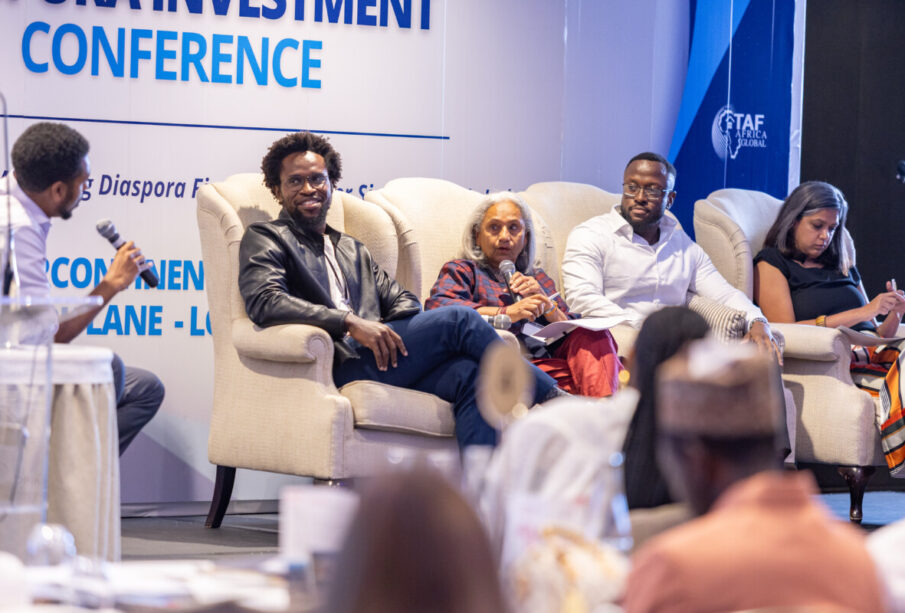
Joevas Asare(far left), Uwem Uwemakpan(left), Parminder Vir OBE (middle), Matthew Mukalere (right), and Roopal Kanabar(far right)
The Market Context: Facts & Stats
- Remittance Volume: Sierra Leone receives $300 million in diaspora remittances annually. Across Africa, that figure rises to $100 billion, and globally across the Global South, it reaches $750 billion.
- Foreign Exchange Risk: Diaspora investors earning in major currencies (Pound, Dollar, Euro) face severe FX volatility when returning capital, creating a significant barrier to scaling institutional-level investments.
- Remittance Costs: High transaction fees remain a barrier; senders often pay standard rates where sending $100 leaves the recipient with only $92. The UN Sustainable Development Goals (SDGs) target reducing remittance costs to 3%.
1. De-Risking Diaspora Capital: Hedging Foreign Exchange
One of the largest hurdles for a UK or US-based investor is currency depreciation. Investing in foreign currency while expecting returns in local currency creates structural risk.
“If we invest in pounds, we’ll get income in pounds. Now when we invest in Africa, the biggest issue that most investors including the diaspora face is actually foreign exchange risk… until we solve for that, capital will not move at scale.” — Roopal Kanabar, Director at Sustainabar
To tackle this, pilot projects are underway in collaboration with institutions like Ecobank to utilize existing private remittance cash flows as FX hedging mechanisms. Sierra Leone is positioning itself to lead this space as a global testbed for FX-hedging remittance models.
2. Moving from Emotion to High-Yield Fundamentals
Historically, diaspora investments have been heavily driven by personal obligation—funding property development, family businesses, or community projects. While emotional connection initiates interest, long-term fund sustainability requires strict financial discipline.
“This was initially just a purely emotional thing like ‘oh my mom’s financially in trouble, let me step in as her son.’ […] But then as I started investing and I was on the ground speaking to people… it showed me that this isn’t just charity. This isn’t just emotion. This is a real opportunity.” — Matthew Mukalere, Software Engineer & Diaspora Investor
When investors combine emotional commitment with rigorous asset management, clear track records, and operational efficiency, diaspora ventures become institutional-grade opportunities.
3. Data, Transparency, and Building Trust
Trust is the foundation of capital deployment. When investors operate from thousands of miles away, opacity increases perceived risk.
“Trust is a downstream problem of data that doesn’t exist about what is happening on the continent… We need to stop being opaque about what it means to build businesses on the continent… How do you build trust when the numbers are vague?” — Uwem Uwemakpan, Head of Investment, Launch Africa
Key Steps to Bridge the Data Deficit:
- Digital Repositories: Governments and private entities must maintain accessible, transparent data rooms detailing active projects, financial reports, and regulatory frameworks.
- Clear Timelines & Accountability: Tracking project milestones publicly reduces information asymmetry and gives investors confidence that capital is deployed effectively.
- Building in Public: Documenting progress, failures, and operational metrics publicly creates a verifiable track record that attracts co-investors.
4. Narrative & Storytelling as Infrastructure
Financial instruments alone do not drive market participation; stories create market perception. Narrative acts as cultural infrastructure that builds investment confidence.
“Capital follows confidence and confidence follows institutions… It is for us to tell those stories. We need to tell our story from our lens rather than the lens from the outsider.” — Parminder Vir OBE, Co-Founder of The African Fund
By controlling the narrative and celebrating entrepreneurial success, nations shift public perception from risk to commercial opportunity. Creative industries—film, digital media, art, and music—play an integral role in establishing cultural visibility and commercial trust across international markets.
The Roadmap Ahead: What Needs to Happen Next?
- Government as an Enabler: Governments must focus on core public infrastructure—energy, connectivity, policy stability, and transparent regulatory environments—enabling the private sector to drive economic development.
- Collective Investment Vehicles: Expanding angel networks (such as the Salon Angel Network) and specialized diaspora investment funds provides individual investors structured pathways to pool capital safely.
- Valuing Knowledge Beyond Capital: Diaspora engagement must move beyond asking for capital to leveraging global networks, technical expertise, market access, and governance capabilities.
Join us in Freetown for Diaspora Week
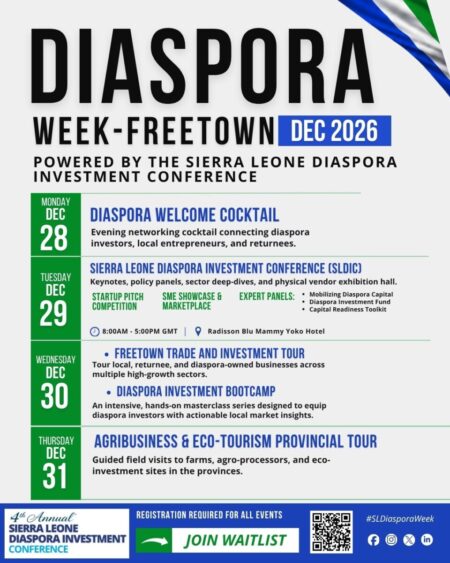
The discussions in London made one thing clear: unlocking diaspora investment requires more than patriotic appeals. It requires trusted institutions, transparent data, innovative financial tools and stronger partnerships between government, the private sector and Sierra Leoneans around the world.
Those conversations will continue at the Sierra Leone Diaspora Week in Freetown on December 29th, 2026.
As Sierra Leone continues building infrastructure needed to unlock diaspora investment, these gatherings offer an opportunity for investors, entrepreneurs, and policymakers to move beyond conversations and toward practical partnerships that can help shape the country’s economic future.
Register Here to Join the Waitlist Now!






-
Kenema Customer Wins NLe114,068 from NLe200 Football Bet.
A 200-leone football bet on 15 teams has turned into a six-figure ... -
-
-