

C-suite mining executive and human resources consultant Aminata Kamara has called for institutional reforms and sustainable investment in women to transform Sierra Leone’s mining sector, saying meaningful gender inclusion must go beyond targets and token representation.
Kamara, who was a moderator at the 2026 Sierra Leone Mining Week held at the Freetown International Conference Centre, formerly Bintumani, made the remarks on Saturday, 23rd May 2026, the closing day of the Sierra Leone Mining Week, where she delivered and moderated a Panel themed “Women in Mining: Beyond Tokenism to Structural Change.”
Her panel brought together women in mining in Sierra Leone, industry leaders, regulators, advocates, and financial sector representatives to discuss progress in promoting women’s participation in mining and the barriers that continue to limit advancement to technical and leadership positions.
Gender Inclusion Requires Intentional Leadership

Image: Aminata Kamara Moderating A Panel Themed “Women in Mining: Beyond Tokenism to Structural Change.”
Drawing on her experience working with institutions, including the World Bank and major mining companies, Kamara said progress in gender equality occurs only when leaders make a conscious effort to create opportunities for women.
“There are companies that say they support gender diversity, and then there are those that design systems that actually make it impossible to ignore women.” Kamara said.
She highlighted the World Bank’s approach to gender mainstreaming, noting that all projects and financing initiatives are designed with gender considerations in mind.
“Every World Bank project has to demonstrate that women and youth are prioritised. Gender consciousness is built into everything the institution does,” she said.
According to Kamara, meaningful change happens when leadership actively promotes women into positions of influence rather than treating inclusion as a compliance exercise.
“You need that sort of leadership. Leaders who deliberately create space for women and want to see women represented in every room and at every level,” she added.
Mining Companies Must Move Beyond Compliance
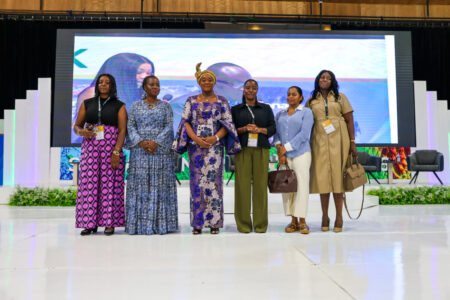
Image: From Right to Left: Ms. Esther Finda Kandeh — Director, Women in Mining, Sierra Leone • Ms. Naasu Fofanah — Board Member, Women in Mining Africa • Ms. Aminata Kamara Mining Professional and HR Consultant • Ms. Hussine Yilla — External Affairs Manager, Sierra Rutile Ltd • Ms. Sangeetha Bala — Human Resources Professional, Meya Mining • Ing. Mariam Khanu — Mining Engineer, National Minerals Agency
Throughout the discussion, Kamara repeatedly stressed that gender diversity should be viewed as a business priority rather than simply a regulatory obligation.
She pointed to examples within the mining sector where deliberate recruitment and promotion policies have increased female participation and strengthened organisational performance.
“Promoting gender diversity should not just be about meeting compliance requirements or ticking a box. It should be a business imperative,” Kamara said.
“A more inclusive and diverse company is ultimately more competitive and more successful.”
Her comments resonated throughout the session as panellists shared examples of initiatives aimed at recruiting, retaining, and developing women across the mining value chain.
Building the Pipeline for Future Women Leaders
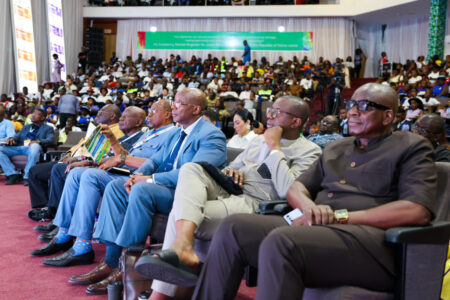
Image: From left to right: Julius Daniel Mattai – Minister of Mines and Mineral Resources, Umaru Napoleon Koroma Esq. – Deputy Minister of Mines
Kamara also emphasised the need to invest in girls and young women long before they enter the workforce.
She argued that encouraging girls to pursue science, technology, engineering, and mathematics (STEM) subjects is critical to increasing female representation in technical roles in mining.
Several panellists echoed this position, noting that stereotypes often discourage girls from considering careers in mining and engineering from an early age.
The discussion highlighted the importance of mentorship, scholarships, graduate trainee programmes, and leadership development initiatives to prepare the next generation of women professionals.
Progress Recorded, But Challenges Remain
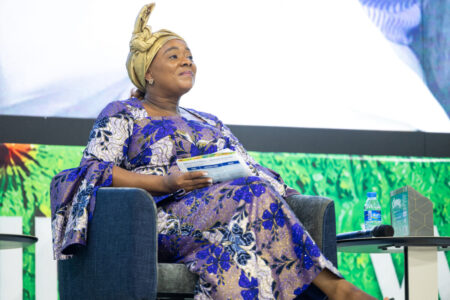
Image: Aminata Kamara Moderating a Panel themed “Women in Mining: Beyond Tokenism to Structural Change.”
While acknowledging the gains made in recent years, Kamara noted that significant challenges remain.
Data presented during the session by the National Minerals Agency showed that women currently account for approximately 18 per cent of employees in mining companies and 20 per cent of participants in artisanal mining operations.
Participants agreed that representation alone is not enough and called for greater participation of women in technical, operational, executive, and decision-making positions.
The panel also identified cultural barriers, limited access to opportunities, and underrepresentation in leadership as key obstacles that still need to be addressed.
A Call for Lasting Structural Change

Image: Minister of Mines and Mineral Resources Julius Daniel Mattai (Left) Alongside Deputy Minister of Mines and Mineral Resources Umaru Napoleon Koroma (Right)
As the final panel of the 2026 Sierra Leone Mining Week, the session concluded with a strong message: the future of mining depends on creating systems that enable women to participate fully and equally.
Kamara said achieving gender equality in mining requires more than good intentions.
“The conversation must move beyond tokenism to structural change,” she said.
“We need intentional leadership, deliberate action, and sustained commitment if we are serious about building a mining sector where women can thrive.”
Her remarks provided a fitting conclusion to the week-long event, which brought together government officials, mining companies, investors, development partners, and civil society groups to discuss the future of Sierra Leone’s mineral sector.




-
Idris Elba Formally Knighted by King Charles III at Windsor Castle
British actor, musician, and activist of Sierra Leonean and Ghanaian descent, Idris ... -
-
-