UNGA 81: World Leaders Confront War, Climate Change and AI Revolution.
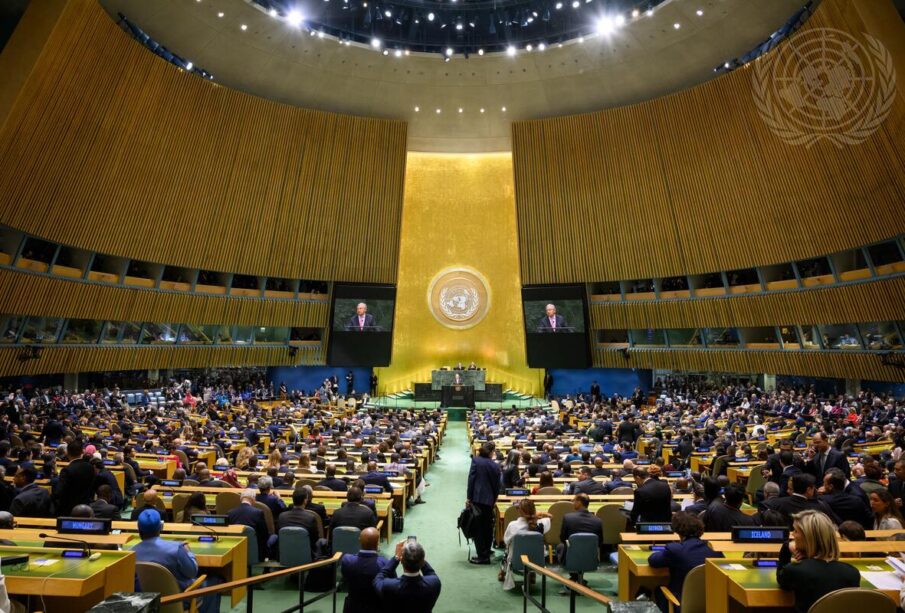
For one week, the world’s attention turned to New York. Heads of state and government, diplomats, international organisations and civil society representatives gathered at the United Nations for the 81st session of the General Assembly (UNGA), where the central theme was Restoring trust, managing transformation: A United Nations that delivers for all.
The General Debate ran from September 22 to September 26, 2026, with proceedings continuing on September 28.
But in all of this, was a much larger question: can the United Nations still bring countries together at a time when wars, geopolitical rivalries, climate change and artificial intelligence are reshaping the world and or turning against each other?
From the opening speeches to heated arguments over war and Palestine, several moments stood out. These moments are carefully captured and analyzed in this article.
Guterres’ Final UNGA Warning Retirement
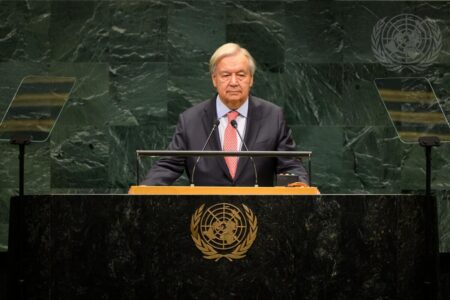
Antonio Guterres giving his final speech at the UNGA81/ image provided by UN.org
One of the most important moments came from UN Secretary-General António Guterres.
Addressing the General Assembly for what is expected to be his final appearance in that role before his term ends on December 31, Guterres warned that the world’s divisions are becoming increasingly dangerous.
He described four major tests facing humanity: peace and security, inequality, climate change and artificial intelligence.
His warning was directed at a world where international institutions are struggling to respond to conflicts and where major powers increasingly disagree over how global problems should be handled.
On Gaza and the wider Middle East, Guterres called for de-escalation and dialogue, saying that fighting must stop, humanitarian assistance must reach civilians and navigational rights must be respected.
He also renewed his support for a two-state solution to the Israeli-Palestinian conflict. But perhaps his most forward-looking warning concerned artificial intelligence.
Guterres argued that AI needs international rules and oversight, particularly because increasingly powerful systems could affect security, economies and people’s lives.
His message was that technological progress should not move faster than humanity’s ability to govern it.
Trump’s Speech Puts America at the Centre
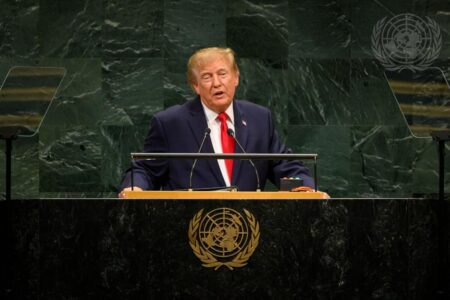
US President Donald Trump giving his speech at UNGA81/image provided by UN.org
US President Donald Trump delivered one of the week’s most closely watched speeches. Trump used the General Assembly to defend his administration’s foreign policy and argue that the United States had moved from talking about international problems to taking direct action. He spoke about Iran, Russia’s war in Ukraine, artificial intelligence, international organisations and US national interests.
On Iran, Trump defended the US decision to enter the conflict and warned that Washington could take further action if a peace agreement was not reached. He also said he expected progress in Ukraine.
His comments on artificial intelligence were equally striking. Trump said the United States would refer to the technology as “super intelligence” and argued that America was leading China in the field. Reuters reported that he also dismissed some warnings about AI safety.
The speech reflected one of the central tensions of this year’s Assembly: whether global problems should be addressed primarily through international institutions or through individual countries pursuing their own national interests.
Palestine Remains at the Centre
The Israeli-Palestinian conflict was another defining feature of the week. Before the General Debate even began, the General Assembly voted 152 to 3 to allow the State of Palestine to participate virtually because President Mahmoud Abbas and members of his delegation had faced difficulties obtaining visas to attend in person.
The United States, Israel and Paraguay voted against the resolution, while four countries abstained. Under the decision, Abbas’s pre-recorded statement could be played in the General Assembly Hall.
The question of Palestine continued through the speeches. Guterres described the destruction and humanitarian situation in Gaza as a major international concern and called for compliance with international law and protection for humanitarian personnel.
Turkish President, Recep Tayyip Erdoğan also used his address to call for greater international pressure over Gaza and urged countries that do not recognise Palestine to reconsider their position.
The speeches revealed once again how deeply divided countries remain over the conflict, while also showing that Palestine continues to occupy a central place in the Assembly’s diplomatic agenda.
Africa Demands a Bigger Seat at the Table
For African leaders, one of the recurring issues was representation. Africa has 54 UN member states and plays a major role in UN peacekeeping, yet it has no permanent seat on the Security Council.
The question of reform therefore featured prominently during the week.
The President of the General Assembly, Khalilur Rahman, said Africa’s continued absence from permanent Security Council membership was difficult to justify and argued that the continent should have a greater role in global decision-making.
Kenyan President William Ruto similarly called for permanent African representation on the Security Council, arguing that the current structure does not adequately reflect the realities of today’s international system.
African countries have long argued that decisions about peace, security, development and international finance often have direct consequences for the continent, while African governments have limited influence over the institutions making those decisions.
Sierra Leone’s Bio Makes the Development Case
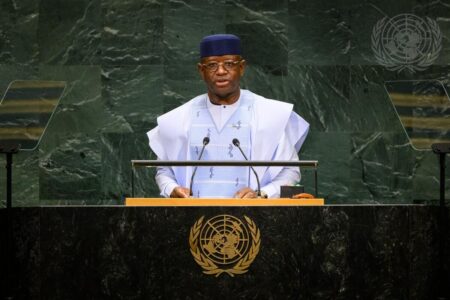
President Julius Maada Bio at UNGA81/image provided by UN.org
Sierra Leone also placed development and global priorities at the centre of its intervention.
President Julius Maada Bio told the General Assembly that the resources being spent on warfare should be matched by stronger investment in peace, development and human security.
He argued that military expenditure continues to rise while many developing countries face major challenges in financing development.
Bio’s speech placed particular emphasis on the connection between peace, development and the needs of poorer countries.
For Sierra Leone, the message was also connected to the country’s wider call for a fairer international system.
The speech allowed Freetown to place issues affecting developing countries, including development financing and global decision-making, within a much larger international debate.
Artificial Intelligence Moves From Technology to Security
AI was no longer treated at the Assembly as simply a technology or business issue. It emerged as a question of international security.
The UN Security Council held discussions on AI during the high-level week, with technology leaders and representatives expected to brief diplomats on the risks and opportunities surrounding increasingly powerful AI systems.
OpenAI CEO Sam Altman was among those scheduled to brief the Council, while Chinese AI company DeepSeek was also expected to participate in discussions around AI and international security.
The concern is increasingly about how AI could influence warfare, misinformation, critical infrastructure, economic systems and human decision-making.
The debate also reflects a growing disagreement over how much regulation is necessary and who should establish the rules.
Climate Change Moves Up the Agenda
Climate was another major issue throughout the week. On September 23, Guterres convened a high-level Climate Summit bringing together governments, businesses, financial institutions and civil society.
The discussions focused on accelerating clean energy, expanding climate finance, strengthening resilience and moving existing climate commitments into practical action.
The Assembly also held a high-level meeting on the threat posed by rising sea levels. That issue is especially important for small island states and low-lying coastal communities, but it also has direct relevance to African coastal countries such as Sierra Leone.
Rising seas threaten settlements, infrastructure, fisheries and livelihoods. The UN meeting sought stronger international cooperation to address those risks.
Development Meets the Reality of War
One of the clearest contrasts running through UNGA 81 was the difference between money spent on military power and money available for development.
The President of the General Assembly pointed to a sharp fall in development assistance while global military expenditure continued to rise.
He argued that countries need to rethink how resources are allocated, including through debt relief, development assistance and reforms to the international financial system.
A United Nations Under Pressure
By the end of the week, one message had become difficult to ignore. United Nations remains the world’s largest forum for international diplomacy, but the organisation is operating in a period of deep political disagreement.
The speeches at UNGA 81 showed sharply different views on war, national sovereignty, Palestine, AI, climate policy and the future of international institutions.
Yet the fact that so many governments continue to use the General Assembly to make their cases also demonstrates its continuing importance as a global meeting place.
The challenge is whether those speeches can produce cooperation after the leaders leave New York. Guterre’s question has become a defining part of his final months as Secretary-General.
African leaders, see this as being tied to representation and a greater voice in global decision-making.
For developing countries, it is linked to finance, debt, climate resilience and development. For the major powers, it is increasingly about how much authority they are prepared to place in international institutions.
And for the wider world, UNGA 81 has offered a clear picture of the problems competing for attention: wars that remain unresolved, a climate system under pressure, an international financial system under strain and an artificial intelligence revolution moving faster than governments can regulate it.
BY FESTUS CONTEH




-
UNGA 81: World Leaders Confront War, Climate Change and AI Revolution.
For one week, the world’s attention turned to New York. Heads of ... -
-
-