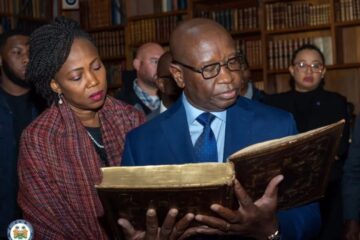
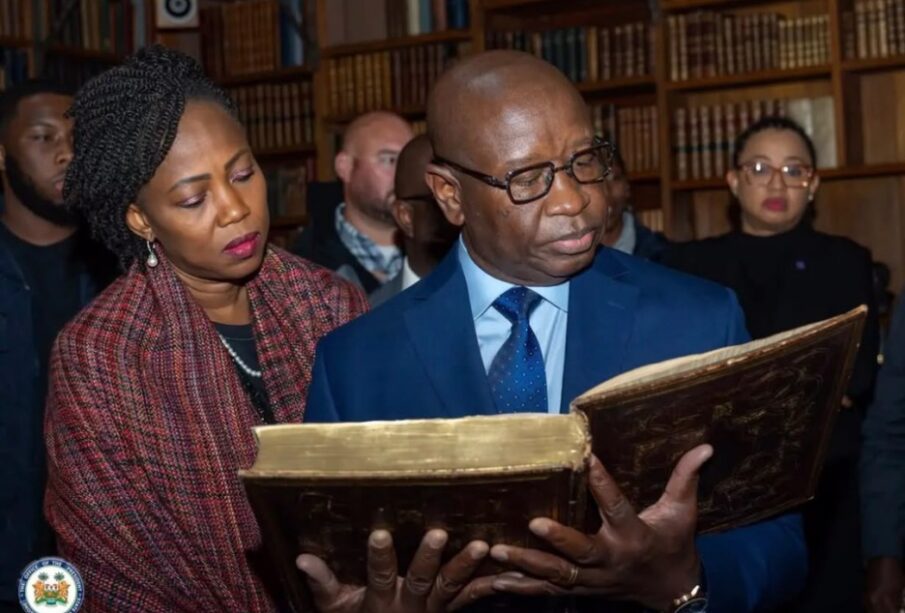
President Bio and First Lady Fatima Bio view the Mende Bible in Quincy, Massachusetts.
“It was a profound honour to visit the Adams National Historical Park and see the Mende Bible on display.”
That was the First Lady of the Republic of Sierra Leone, Fatima Maada Bio’s remark this week after she and President Julius Maada Bio viewed one of the most important artifacts in Sierra Leonean-American history: the Mendi Bible, sitting 4,500 miles away from where it was first intended to be read.
While official reports focused on President Bio’s call for reparatory justice, the images of the First Family in a quiet, book-lined library in Quincy raise a bigger, unasked question: Why is Sierra Leone’s most powerful symbol of freedom still in storage in Massachusetts?
The Bible That Crossed the Atlantica
The Mendi Bible, as it is officially called by the US National Park Service, is kept in the Stone Library next to Peacefield, the home of former US President John Quincy Adams, at the Adams National Historical Park.
According to the Park Service, 53 freed Africans led by Sengbe Pieh gave it to Adams on November 6, 1841. The inscription inside reads:
“For the Mendi people, Cinque, Kinna, Kale. Boston, Nov 6, 1841.”
It was a thank-you gift.
Two years earlier, in 1839, Sengbe Pieh and fellow Mende captives from what is now Sierra Leone, were illegally enslaved aboard the Spanish schooner, La Amistad. Their revolt sparked a landmark case that went to the US Supreme Court. A 73-year-old John Quincy Adams argued for 4.5 hours for their freedom. In 1841, the Court ruled they were free men.
The Bible was their gratitude.
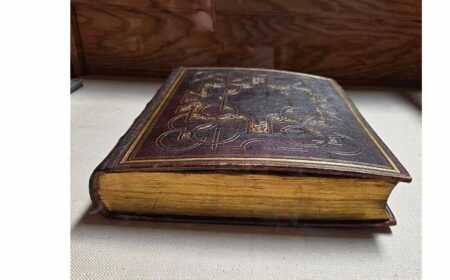
The 1841 Mendi Bible
Stolen, Recovered, Hidden
Few Sierra Leoneans know the Bible’s dramatic recent history.
It is not always on public display. In November 1996, thieves stole it from the Adams National Historical Park. The FBI recovered it two months later, in January 1997, inside a gym locker in Portsmouth, New Hampshire.
It is considered so sacred in American history that in 2007, Massachusetts Governor Deval Patrick, the state’s first Black governor, took his oath of office on the Mendi Bible. He used it again in 2011.
Yet no President of Sierra Leone has ever taken an oath on it.
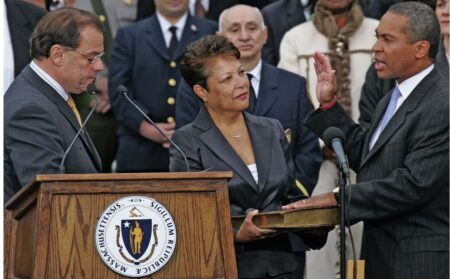
Massachusetts Governor Deval Patrick taking the oath of office on the 1841 Mendi Bible.
From Bonthe to Boston And Back?
For First Lady Fatima Bio, the visit carried a personal meaning other outlets missed.
“For both of us, the connection between Bonthe and this historic place carries a very special meaning,” she wrote, noting that President Bio hails from Bonthe District, an island that was itself a major hub of the transatlantic slave trade.
“From Boston to Bonthe, this history continues to connect our peoples.”
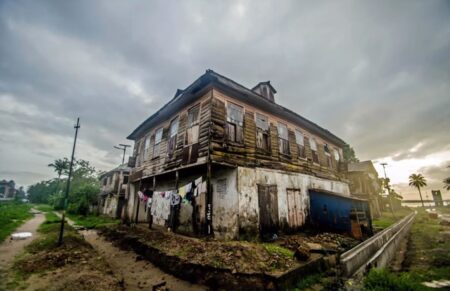
A dilapidated colonial building in Bonthe, Sherbro Island.
President Bio, speaking on Sunday, September 27, 2026, at the United First Parish Church in Quincy under the theme Celebrating Courage: Honouring the Historic Link Between Quincy and Sierra Leone, described the Bible as “a witness to history and a sacred link” and an “enduring symbol connecting Sierra Leone and the United States across generations.”
But if it is a sacred link, should that link live permanently in Quincy?
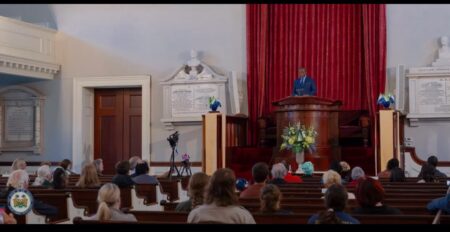
President Bio speaking at the United First Parish Church in Quincy, Massachusetts, during the viewing of the Mende Bible.
As global debates grow over the repatriation of African artifacts from the Benin Bronzes in the British Museum to the call for African cultural restitution, the Mende Bible presents Sierra Leone with a unique case.
Nobody looted it. Mende ancestors gave it freely. But it remains inaccessible to the Mende people whose story it tells.
Does reparatory justice, which President Bio invoked in Quincy, include cultural repatriation? Should Sierra Leone request a long-term loan, a high-quality replica for a future Amistad museum in Bonthe, or even a shared custody arrangement where the Bible travels to Freetown?
Currently, there is no dedicated Amistad or Mende Bible museum in Bonthe or Freetown. Quincy, Massachusetts, preserves this Mende history now.
The First Lady’s quiet moment in the Stone Library may have opened a new conversation, not just about remembering the past, but about who should keep it.
WRITTEN BY DEBORAH KAMARA





-
A Sacred Mende Bible Sits in a Massachusetts Library: Should Sierra Leone’s Symbol of Freedom ...
“It was a profound honour to visit the Adams National Historical Park ... -
-
-