President Bio UNGA81 Speech: 5 Key Messages for Africa
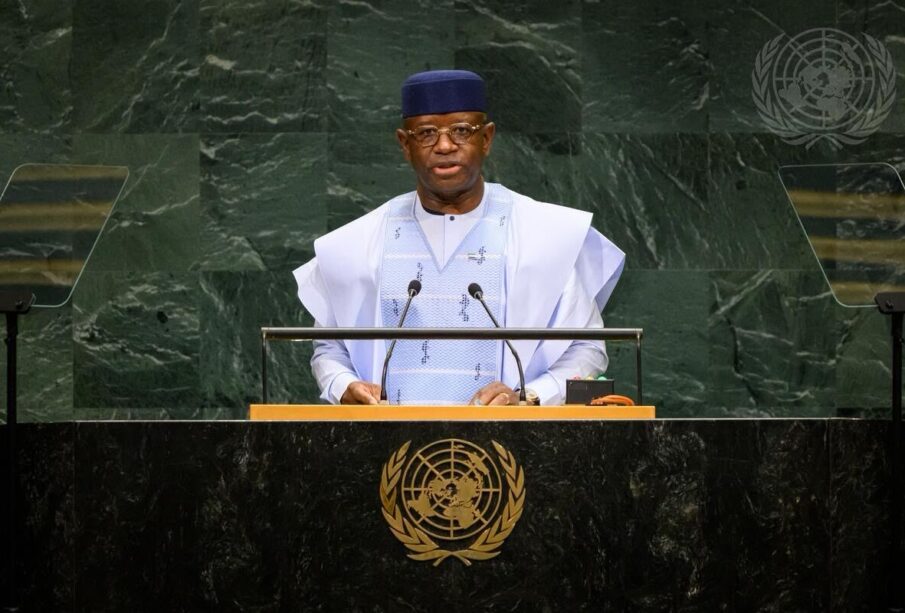
H.E. President Julius Maada Bio stood before world leaders at the United Nations General Assembly in New York on September 22, 2026, and made a bold speech.
The President cited Sierra Leone’s experience of civil war, peacebuilding, and recovery to make a broader argument about a world facing war, inequality, climate change, technological transformation and declining trust in international institutions.
Addressing the General Debate of the 81st Session of the United Nations General Assembly, Bio spoke under the theme “Restoring Trust, Managing Transformation: A United Nations That Delivers for All.”
For Sierra Leone, the UNGA81 engagement extended beyond the President’s main speech. The country’s delegation used the week to raise issues ranging from Africa’s representation on the Security Council and the management of critical minerals to child marriage, investment, climate change, and development financing.
From Sierra Leone’s Civil War to a Global Argument for Peace
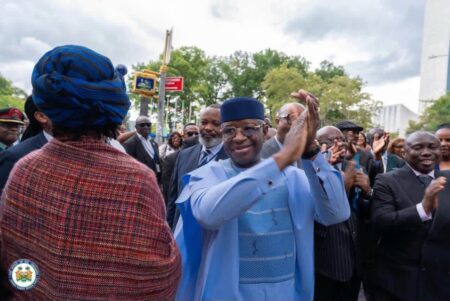
President Bio welcomed by some Sierra Leoneans at the UN Conference
Bio began by recalling Sierra Leone’s own journey from war to peace.
Nearly 25 years after the country formally ended its civil war.
He told the Assembly that peace became meaningful through the return of families, reconciliation in communities, participation in elections, and the rebuilding of institutions.
The United Nations played a significant role in Sierra Leone’s post-war transition through disarmament, elections and peacebuilding, according to Bio’s account.
That history shaped one of the central messages of his address.
Bio argued that military action alone cannot create lasting peace when poverty, unemployment, exclusion and weak institutions continue to create conditions for insecurity.
He pointed to conflicts in Sudan and the eastern Democratic Republic of Congo, as well as terrorism across West Africa and the Sahel.
“Military action may contain a threat, but it cannot by itself build lasting peace,” he told world leaders.
Bio then connected peace directly to development, arguing that governments must put resources behind the relationship between the two.
The Cost of War Versus the Cost of Development
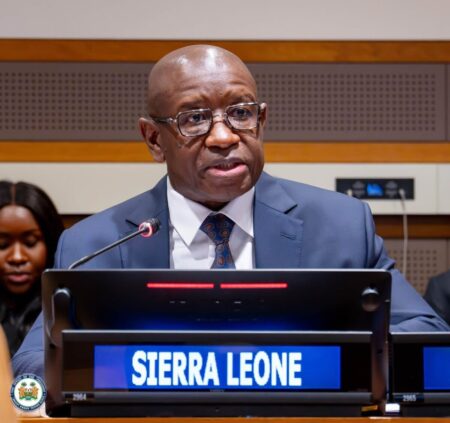
President Bio speaking at the UNGA81
One of the strongest economic points in Bio’s speech was his reference to global military spending.
He highlighted that global military expenditure reached about $2.9 trillion in 2025, marking the 11th consecutive annual increase. The figure was used to question whether enough resources are being committed to preventing the conditions that produce conflict.
Bio’s argument was that security cannot be separated from development.
He called for greater investment in jobs, skills, and opportunities, particularly for young people.
For a country like Sierra Leone, where youth employment and economic opportunity remain major development priorities, the argument also connected international peace with domestic development.
Africa Wants a Seat Where Global Decisions Are Made
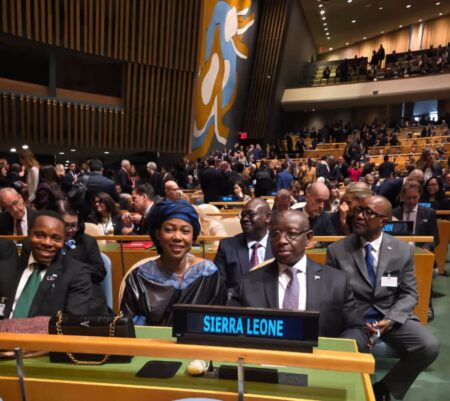
Chief Minister David Sengeh (left), First Lady Fatima Bio (middle), President Bio (right), and the Sierra Leonean Entourage
Another major part of Sierra Leone’s intervention was the question of Africa’s representation at the United Nations Security Council.
Bio argued that the current structure still reflects the geopolitical realities of 1945 rather than today’s world. Africa, he argued, has more than 1.6 billion people but does not have a permanent seat on the Security Council.
Sierra Leone has particular involvement in the issue. The country is serving as coordinator of the African Union Committee of Ten, which works to advance the continent’s common position on Security Council reform.
In his address, Bio said Africa’s position calls for at least two permanent seats and five non-permanent seats for the continent, in line with the Ezulwini Consensus and the Sirte Declaration.
The issue was also part of Bio’s bilateral meeting with UN Secretary-General António Guterres.
According to Sierra Leone’s State House, Guterres reaffirmed his support for greater African representation on the Security Council and international financial institutions.
Critical Minerals and Africa’s Next Economic Chapter
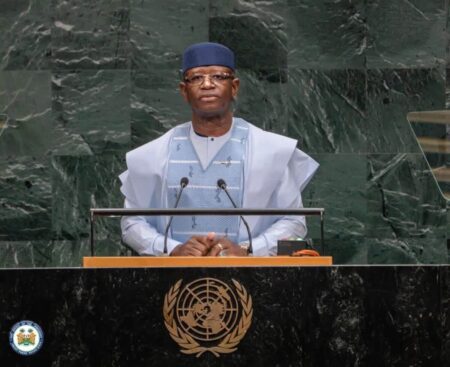
President Bio on the UNGA81 podium
Bio also used UNGA81 to address one of Africa’s increasingly important economic questions: how the continent benefits from its natural resources.
Sierra Leone is rich in mineral resources, and Bio’s argument extended beyond his own country to Africa’s role in the global energy transition.
He argued that critical minerals needed for the transition to cleaner energy should not simply be extracted in Africa and processed elsewhere. Instead, he called for processing at the source, fair value chains, technology transfer, and local industries.
“The green transition must not reproduce the extractive terms of the past,” he said.
The message had already featured prominently in Bio’s activities in New York before his UNGA address.
At UNSTOPPABLE AFRICA 2026. he called for African countries to move beyond exporting raw materials and develop processing and manufacturing capacity on the continent.
He linked value addition to industrialization, economic transformation, and employment for young people.
Child Marriage Highlighted at UNGA
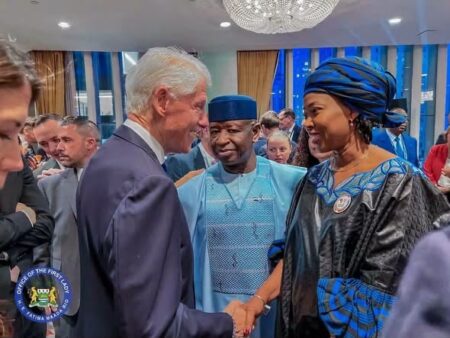
President Bio (middle), Bill Clinton (left) & Fatima Bio (right) at the UNGA81
Sierra Leone’s presence at UNGA81 was not limited to Bio’s General Debate speech.
On the margins of the Assembly, Bio joined a high-level event focused on ending child, early and forced marriage.
Sierra Leone had been the main sponsor of a resolution adopted by consensus on September 4 establishing November 27 as the International Day for the Elimination of Child, Early and Forced Marriage.
However, eighty-four countries co-sponsoring the initiative, according to State House.
At the New York event, Bio announced three further commitments.
Sierra Leone will develop a national action plan to eliminate child, early and forced marriage, strengthen implementation of the Prohibition of Child Marriage Act through enforcement, registration, education and community engagement, and report on progress beginning with the first International Day on November 27, 2026.
The President also linked the issue to girls’ education and healthcare, pointing to Sierra Leone’s Free Quality School Education programme, Radical Inclusion Policy and Gender Equality and Women’s Empowerment Act.
What Sierra Leone Took to New York
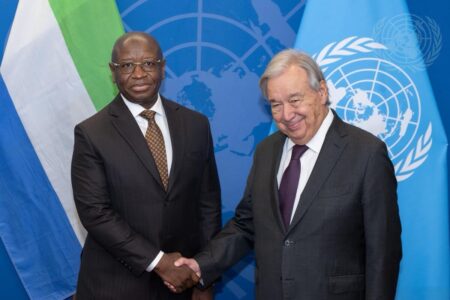
President Bio shaking hands with Secretary-General of the UN, António Guterres
Sierra Leone’s presence at UNGA81 therefore went beyond one speech.
The country’s message was built around several connected issues.
There are: peace must be supported by development, Africa needs a stronger voice in global decision-making, African resources should generate greater value on the continent, developing countries need a fairer financial system, and emerging technologies should not deepen existing inequalities.
For Sierra Leone, the country’s own history provided the foundation for many of those arguments.
A nation that experienced war, relied heavily on international peacebuilding. Also it continues to face development challenges used the world’s largest diplomatic stage to argue that peace cannot be separated from economic opportunity, inclusion and accountable institutions.
As Bio put it at the end of his General Assembly address, the words “For All” in the UNGA81 theme should not remain simply part of the slogan.
For Sierra Leone, the test is whether those words can translate into decisions on peace, development, representation, climate finance, technology and opportunity that are felt beyond the UN chamber in New York.



-
President Bio UNGA81 Speech: 5 Key Messages for Africa
H.E. President Julius Maada Bio stood before world leaders at the United ... -
-
-